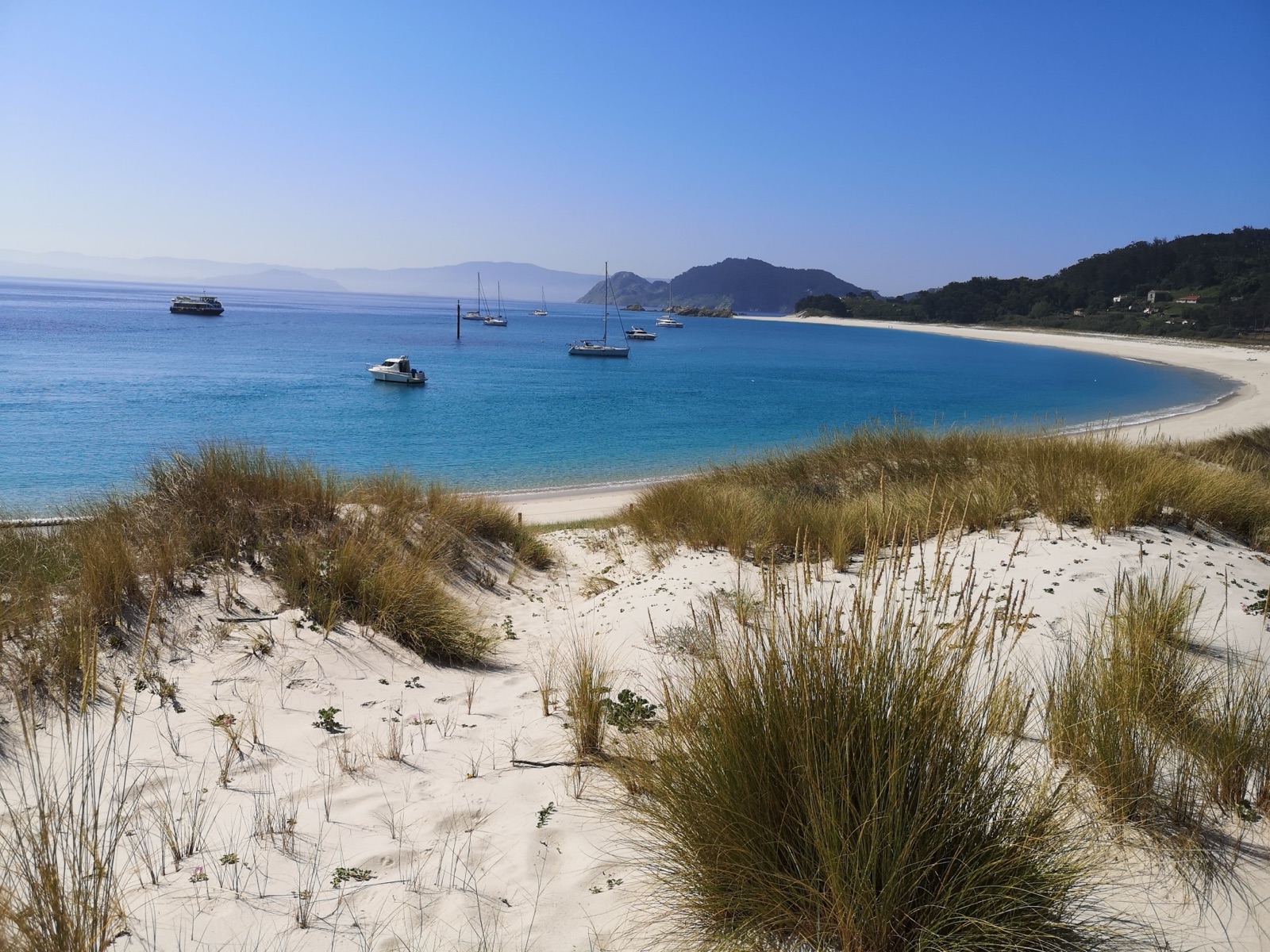
Snorkelling, Kayaking and Diving at the Cíes Islands: Guided Trips, Permits and Sea Temperature
The water around the Cíes Islands is part of the national park too, and some of the best of the islands is below the surface or seen from it. In summer you can join a guided snorkelling outing (from €30) or a guided sea-kayak trip (from €20 booked online), both starting at the campsite; scuba diving needs a written permit from the park, which dive centres arrange for you; and you can swim from any of the beaches, in water that stays cool all year. Sailing or motoring over in your own boat needs park permits of its own.
This guide covers each activity: what it costs, who can do it, when it runs, and the rules that protect the sea around the islands.
At a glance
| Activity | Season | Price | Minimum age | Permit |
|---|---|---|---|---|
| Guided snorkelling | 1 June to 15 September | €30 in June, €35 July to September | Over 10, able to swim | Only the visitor permit |
| Guided sea kayaking | 1 June to 15 September | €25 / €35 on the island, €20 / €30 online | 12, able to swim | Only the visitor permit |
| Scuba diving | With a dive centre | e.g. €40 single, €60 double | Over 16, certified | Park diving permit |
| Swimming | Any time; lifeguards in summer | Free | n/a | Only the visitor permit |
| Your own boat | Any time | n/a | n/a | Navigation and anchoring permits |
In high season every visitor still needs the free Xunta permit to land on the islands; see the getting there guide.
What lives in the water
The Cíes sit at the mouth of the Vigo estuary, where Atlantic water meets the estuary, and the sea around them is rich. Below the cliffs the rocky seabed holds velvet crabs, spider crabs, lobsters and octopus, while the sheltered rocks inside the islands carry forests of anemones and many sea urchins. The archipelago has more than 200 kinds of seaweed, and the campsite’s snorkelling outing promises clear water where more than 100 marine species live.
Further out, dolphins, whales and sea turtles regularly visit the waters around the islands. From a kayak you are also close to the seabirds: 22,000 pairs of yellow-legged gulls form the largest colony in the world, and 2,500 pairs of shags also breed here.
Snorkelling
The guided outing
The simplest way to snorkel is the guided outing run from the campsite by a spearfishing and diving federation (no spearfishing here, of course: it is banned in the park).
- When: from 1 June to 15 September, 12:00–15:00 and 17:00–20:00, meeting in front of the campsite showers a few minutes before.
- Price: €30 in June and €35 from July to September.
- How long: 2 to 3 hours.
- Equipment provided: a guide, wetsuit, safety buoy, fins, mask and snorkel. Bring footwear for getting to the water’s edge.
- Who can go: snorkellers must be able to swim and be over 10; 10- to 15-year-olds go with an adult.
- Who it is for: campers and day visitors alike.
The outing starts with a short introduction on the natural setting, safety and the equipment, and then moves into clear, shallow water. Common octopus, moray eels, blennies, sponges and seaweed are among the life on the snorkel route.
Snorkelling on your own
You can also snorkel from the beaches with your own mask and fins. A few pointers:
- Pick the sheltered side. All three islands are mountainous, with near-vertical western cliffs over 100 m high and many sea caves, while the gentler, sheltered eastern slopes hold woods, beaches and dunes. The eastern beaches face the estuary and are the place to swim and snorkel; the western side is for looking at, not swimming off.
- Wear a wetsuit. The Atlantic here is cold (see below), and a wetsuit keeps you in the water long enough to enjoy it.
- Never snorkel alone, and keep to calm, clear days.
- Look, do not take. Collecting shells from the beaches or seabed is not allowed, and spearfishing and sport fishing are forbidden.
Sea kayaking
The guided route
The sea-kayak trip is the best way to see the islands from the water without a boat of your own. The route was designed with park staff supervision and the campsite, in double sea kayaks, with a guide in a support dinghy. It stops at fixed points to rest, explain and take photographs, and the guides take free photos along the way.
- When: 1 June to 15 September, 12:00–14:00 and 16:00–18:00, meeting at campsite reception a few minutes early. Kayak trips leave daily at 12:00 and 16:00.
- Price: €25 in June and €35 from July to September on the island, or €20 and €30 booked online.
- How long: 2 hours from the introduction to the return.
- Who can go: kayakers must be able to swim and be at least 12; 12- and 13-year-olds go with an adult, and 14 to 18-year-olds may go alone with a signed form.
- Provided: a guide, life jackets, paddles, a viewing scope and a mini monocular; bring sun protection and shoes you can wear to the water’s edge.
The kayak route passes the old Santo Estevo convent, oystercatchers, the view of Conchas beach and cormorants. It is a gentle, educational paddle rather than a workout, and the double kayaks are stable even for beginners.
The kayak operator recommends booking mornings, when the sea is usually better: the wind often rises in the afternoon.
Getting there in time
If you are a day visitor, plan your boat around the activity. Day visitors joining an activity are told to take one of the first boats, at 09:00, 09:30 or 10:15. That gives you time to walk from the jetty to the campsite (800 m from the information hut) before the midday start.
All establishments on the island take cards, except the activities, which are paid in cash, so bring enough cash if you plan to pay on the island.
Scuba diving
The permit
Diving in park waters needs written permission, requested online through the national parks’ booking site or at the park office. The park’s general rules put it the same way: scuba diving with weights needs prior permission. The park office is in the Edificio Cambón, Calle Palma 4, in Vigo’s old town.
In practice, most visiting divers go with a dive centre from Vigo or the estuary, which applies for the permit on their behalf.
Diving with a centre
As an example of what to expect, one Vigo dive centre charges €40 for a single dive and €60 for a double at the Cíes. Its requirements:
- Divers must be over 16, hold Open Water certification and diving insurance, and give their details in advance so the centre can arrange the park permit. Insurance can be taken out at the centre.
- You give your ID details, name, address and phone number ahead of time.
What you see
This is cold-water Atlantic diving, not tropical reef. Divers meet spider crabs, octopus, velvet crabs and lobsters, with goose barnacles, sea urchins, turbot, sole and anemones near the rocks. The rocky walls below the cliffs, the anemone forests in sheltered water and the sandy beds off the beaches each have their own life.
Swimming
The beaches
The archipelago has nine beaches in all, mostly on the sheltered eastern side.
- Rodas is the main beach, 1.3 km long and 60 m wide, by the jetty, with the most facilities and summer lifeguards.
- Nosa Señora (Nuestra Señora), also called Carracido, is 140 m long and 20 m wide, a small, sheltered bay that the campsite recommends when the wind is from the north.
- Figueiras is 350 m long and 50 m wide, reached by a path near the Rodas jetty; it is a nudist beach with trees giving shade on the hottest days.
- Bolos, also called Conchas for its many shells, is at the end of Rodas beach.
The walks and beaches guide describes each beach and the paths between them.
Safety
- Lifeguards: a first-aid point operates only in high season, at the campsite, and Vigo usually provides beach lifeguards in summer; staff arrive on the first boat and leave on the last. Outside those hours and months, you are on your own.
- The lagoon: at high tide the sea flows between the two islands on the west side and fills the lagoon behind Rodas beach. It is a protected area for looking at, not swimming in.
- Wind and currents: stay on the sheltered side, and out of the water when it is rough.
- Dehydration: the islands are windy, with a lot of salt in the air, which together with the sun makes dehydration likely. Bring water: there is no drinking water from the islands’ fountains, though it can be bought on the island.
How cold is the water?
The Atlantic here is cool all year, and colder than the sunshine suggests.
- On neighbouring Ons, the water is usually about 15 degrees in summer, so a simple wetsuit is advised for snorkelling.
- The sea warms slowly and holds its heat: in October 2024 the average sea-surface temperature at the Cíes was 16.66 degrees, close to that of the previous July.
- Since records began in 1982 the sea around the Cíes has warmed from about 15 to 16.5 degrees on average.
For a long snorkel, a wetsuit is the difference between ten minutes and an hour. The guided outing provides one. The best time to visit guide has more on the seasons.
Visiting in your own boat
The permits
If you sail or motor over in your own boat, the visitor permit for the ferries is not what you need. Sailing and anchoring in park waters without the corresponding permit is not allowed.
- Sailing and anchoring in park waters need written permission; the navigation permit, a prerequisite for the anchoring permit, is requested with forms sent to the park office, while the anchoring permit can be obtained online.
- The park regulates daily entries by day visitors, campers and private boats at anchor, with set anchoring zones, so anchoring places are limited too.
- Apply well ahead of a summer visit, and check the national parks’ booking site for the current procedure.
Why bring a boat?
A boat opens up a corner of the islands the ferries do not reach. San Martiño beach, 520 m long, can only be reached by your own boat, because the ferries do not serve San Martiño island. The south island is otherwise cut off: Faro island and San Martiño are separated by a strait of about 500 m, the Freu da Porta.
A skippered sailing trip
If you do not have a boat, the next best thing is a skippered trip. The full-day sailing trip with a skipper sails from Vigo, with a picnic on board, snorkelling and paddleboarding, anchoring off the islands so you can walk to the lighthouse; it lasts about 8 hours. It combines the water and the land in one day, without dealing with permits for a private boat. See the tours page for current options.
Which water activity suits you?
- First time in the sea with a mask: the guided snorkelling outing. The guide, the wetsuit and the safety buoy take care of the nerves, and the guide knows where the octopus hide.
- Families with older children: snorkelling from age 10, kayaking from age 12. Younger children are happiest on the sheltered beaches; the Cíes with kids guide has ideas for them.
- Birdwatchers and photographers: the kayak route. It brings you close to the shags and oystercatchers at sea level, which the paths cannot, and the guides stop at set points for photographs.
- Certified divers: a dive with a centre from Vigo, booked in advance so the permit is in place.
- Strong swimmers who like to explore alone: your own mask and fins on a calm morning, on the sheltered side, with a friend.
- Anyone short of time: a swim at Rodas or Nosa Señora between the walk and the boat home.
Combining the water with the walks
A water activity takes a good part of a day, so it is worth thinking about the order.
- Activity at midday, walk in the afternoon. The kayak and snorkel trips start at midday, so take an early boat, walk to the campsite, and do the lighthouse route afterwards, taking the last boat back.
- Walk early, swim late. If you are not booking an activity, do the Monte Faro route first, while it is cool, and keep the swim for the afternoon, when the beaches start to empty.
- Stay the night. With a night at the campsite, a morning walk, a midday paddle and an evening swim all fit comfortably. The camping guide explains how to book.
Whatever the plan, carry water, food and sun protection, and keep a dry layer in your bag: after time in the Atlantic, the wind on the beach can feel cold even in August.
The rules in the water
The sea is protected as strictly as the land.
- Spearfishing and sport fishing are forbidden.
- Park rules forbid carrying children’s shrimping nets, weapons, harpoons or spearguns.
- Collecting shells from the beaches or seabed is not allowed.
- Scuba diving with weights needs prior permission.
- Sailing and anchoring need permits.
- Drones and kites need express permission from the national park, which matters if you planned to film from above.
- Filming or photographing for commercial purposes needs prior permission.
Planning a day on the water
- Book the visitor permit (in high season) and an early boat.
- Book the activity online in advance for the lower kayak price and a guaranteed place, choosing a morning slot if you can.
- Bring cash for activities paid on the island, a swimsuit, a towel, sun protection and shoes for the water’s edge.
- Leave valuables in a locker: lockers about 60 x 40 x 40 cm can be rented for €5 a day plus a €5 deposit, by day visitors too.
- Walk or swim in the afternoon, and take a late boat back.
Frequently asked questions
Can you snorkel at the Cíes Islands?
Yes. You can snorkel from the sheltered beaches, or join the guided outing from the campsite from 1 June to 15 September, with all the equipment provided.
Do I need a permit to dive at the Cíes?
Yes. Diving in the national park needs written permission from the park. Dive centres usually arrange it for you if you give them your details in advance.
Can I kayak to the Cíes Islands?
The guided kayak trip starts on the islands themselves, from the campsite. Crossing to the islands in your own vessel needs the park’s navigation and anchoring permits.
Is the water warm enough to swim?
It is cool all year: on average about 16.5 degrees at the surface, with the warmest water from late summer into autumn. Most people swim in summer, and a wetsuit helps for snorkelling.
Can you go to San Martiño island?
Only by your own boat, with the park’s permits: the ferries do not serve it.