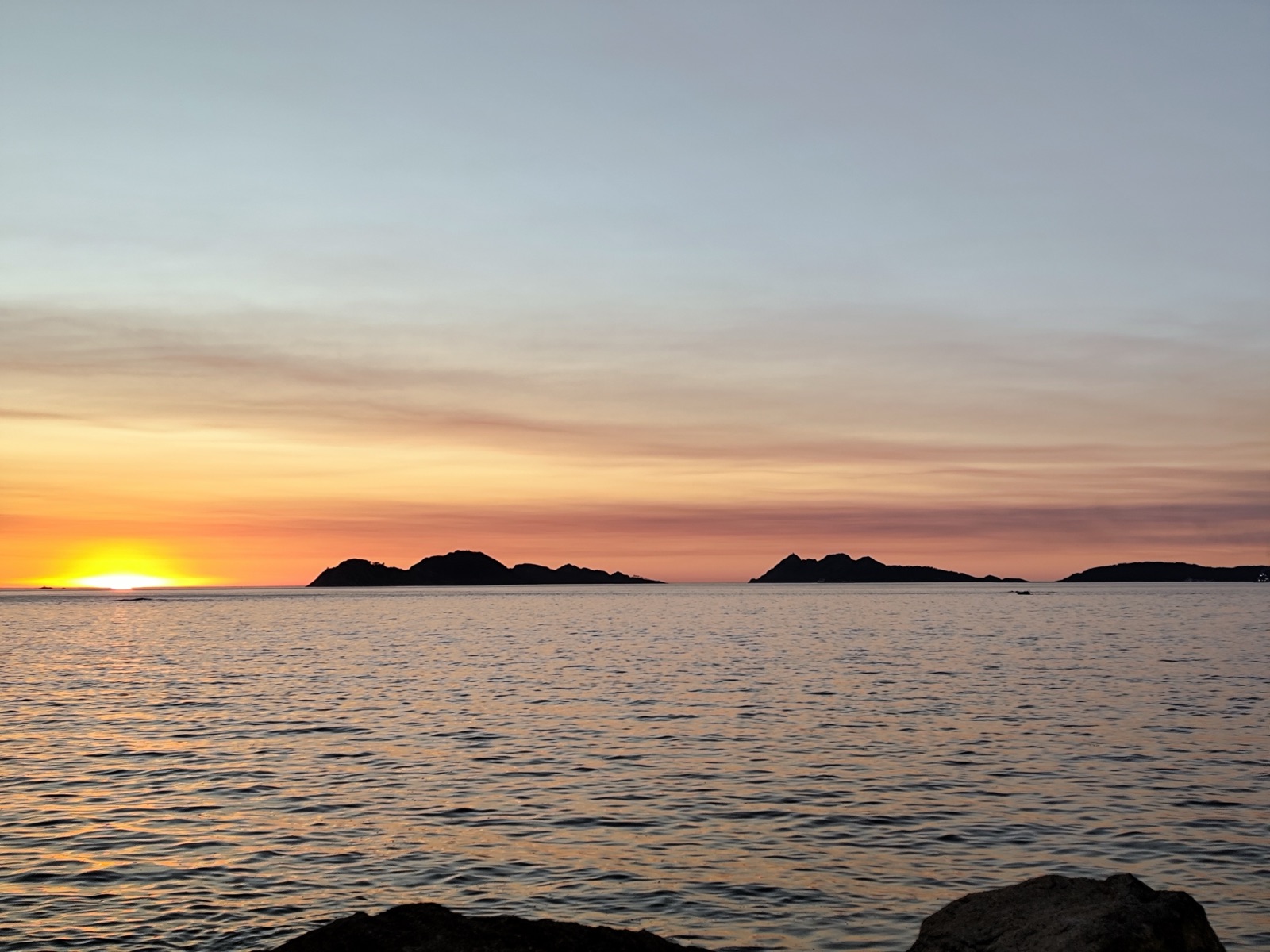
Best Time to Visit the Cíes Islands: Month by Month, Crowds, the Permit Season and Low Season
Cíes Islands weather this week
Monte Faro lighthouse (178 m)
The five-day forecast for Monte Faro lighthouse, updated through the day.
Forecast data from MET Norway (CC BY 4.0), summarised by day.
The best time to visit the Cíes Islands for most people is June or the first half of September: the weather is close to its summer best, every boat, café and activity is running, and the crowds of July and August have not yet arrived or have gone home. July and August are the hottest, sunniest and busiest months, when permits for popular days run out. From mid-September to mid-May the islands are in low season: no permit is needed, visits are made in guided groups, and the islands are quiet, but boats are fewer and the weather is much less reliable.
This guide goes through the year month by month, explains how the permit season shapes the crowds, and helps you pick the right day and the right time of day.
The short answer
| If you want… | Go in… |
|---|---|
| The best all-round balance | June, or 1 to 15 September |
| The warmest, sunniest weather | July or August, booking the permit early |
| Swimming in the warmest sea | August to October |
| The fewest people | Low season, from 15 September to 15 May (except Easter) |
| Camping | Easter week or 15 May to 14 September, the campsite’s season |
| Kayaking or snorkelling | 1 June to 15 September, when the operators run |
How the year works on the Cíes
Two calendars shape a visit more than the weather does.
The permit calendar. In high season (Holy Week and 15 May–15 September) each visitor needs a free permit from the Xunta before travelling, because the islands have a daily visitor limit. For 2026, the Xunta’s permit site gave the Easter period as 27 March to 5 April. The quota is 1,800 visitors a day for the Cíes Islands. On other dates you do not need to request a permit yourself: you arrange the visit directly with an approved ferry company.
The services calendar. The cafés, the campsite and the activities follow the boats. The campsite’s 2026 opening was Easter week (27 March to 4 April) and from 15 May to 14 September. The snack bar and supermarket open 15 May to 15 September; the kayak and snorkel trips run 1 June to 15 September; the free children’s activities run at weekends in June and daily from 20 June to 6 September. A first-aid point operates only in high season, at the campsite, and Vigo usually provides beach lifeguards in summer.
Put together, that gives three distinct seasons for a visitor: high season with everything open, a short shoulder at each end, and a long, quiet low season.
Month by month
The figures below are AEMET’s long-term averages for Vigo airport (1981–2010), the nearest long climate record. The islands sit at the mouth of the estuary and are often windier, and slightly milder in winter, than an inland airport, so read them as a guide to the pattern rather than the exact numbers.
| Month | Day / night | Rain | Rain days | Sunshine |
|---|---|---|---|---|
| January | 11.9 °C / 5.4 °C | 208 mm | 14.0 | 114 h |
| April | 16.6 °C / 8.2 °C | 157 mm | 13.5 | 193 h |
| May | 18.8 °C / 10.4 °C | 127 mm | 12.4 | 228 h |
| June | 22.5 °C / 13.2 °C | 62 mm | 6.9 | 273 h |
| July | 24.4 °C / 14.8 °C | 44 mm | 5.0 | 296 h |
| August | 24.7 °C / 15.0 °C | 45 mm | 4.7 | 287 h |
| September | 22.8 °C / 13.8 °C | 102 mm | 7.8 | 212 h |
| October | 18.8 °C / 11.2 °C | 231 mm | 13.1 | 154 h |
| November | 14.9 °C / 8.2 °C | 246 mm | 13.1 | 112 h |
The weather page in this site’s menu has the full twelve-month table and a live five-day forecast for the islands.
January to March
The wettest, darkest part of the year, with January averaging 208 mm of rain on 14.0 days. Boats still sail in low season, with a guided walk, but the Atlantic decides: sailings are often cancelled in storms. Choose a calm, dry day from the forecast and dress for wind. The reward is near-empty islands and the winter light on the cliffs.
Easter
Easter is a mini high season. The permit is needed, the quota applies, the campsite opens, and the boats from the smaller ports run. At Easter, though, the campsite’s supermarket and bar are closed, and the starlight tours, snorkelling and kayaking are not available. The weather is still spring weather: April averages 16.6 °C by day, with 157 mm of rain on 13.5 days. Book the permit early if your dates fall on the Easter weekend itself.
April and the first half of May
Between Easter and 15 May the islands are back in low season. The days lengthen, the woods and dunes are green, and the gull colony is at its loudest, but rain is still frequent. It is a fine time for walkers who do not need to swim and who are happy to join a guided group.
15 May to the end of June
The season opens on 15 May: the permit is needed again, the campsite, snack bar and supermarket open, and the boats from Baiona and the Pontevedra estuary resume. May is still changeable (127 mm of rain on 12.4 days), but June is the turning point, with 22.5 °C by day, 62 mm of rain on 6.9 days and 273 hours of sun. Weekdays in June are the sweet spot of the whole year: summer weather, full services, and permits that are usually easy to get.
July and August
The peak. July averages 24.4 °C by day with 44 mm of rain on 5.0 days and 296 hours of sun; August 24.7 °C and 287 hours. Everything is open, the lifeguards are on Rodas, and the evenings are long. The price is crowds: the quota is often reached on weekends and holidays, the boats and car parks at the ports fill, and fares are at their highest (as an example, Nabia’s return fares from Vigo or Cangas are €27 in July and €29 in August and September). Book the permit as soon as your dates are fixed; permits can be requested up to 90 days ahead.
1 to 15 September
The second sweet spot. The sea is at its warmest, the summer crowds thin once Spanish schools return, and the services keep running until the middle of the month. September still averages 22.8 °C by day, though rain returns (102 mm on 7.8 days). The campsite’s low season runs from 6 to 14 September, and the permit system and the quota apply until 15 September.
16 September to the end of October
Low season begins. From 15 September to 15 May (except Easter) you do not need to request a permit yourself, and with Nabia, for example, the ticket includes a guided walk. The campsite closes, and Nabia advises checking whether any of the places to eat are open. October can still bring beautiful days, and, in recent years, surprisingly warm sea; but it is also one of the wettest months (231 mm on 13.1 days).
November and December
Dark, wet and windy (November: 246 mm of rain on 13.1 days), with the shortest days of the year. Visits are possible on calm days with a guided group, but expect the boats to be cancelled when the Atlantic is rough.
The sea: when is it warmest?
The Atlantic here is cool all year. On neighbouring Ons, the water is usually about 15 degrees in summer, so a simple wetsuit is advised for snorkelling. The sea warms slowly and holds its heat late: in October 2024 the average sea-surface temperature at the Cíes was 16.66 degrees, close to that of the previous July, and that October the sea at Rodas was warmer than it had been in June. Over the longer run, since records began in 1982 the sea around the Cíes has warmed from about 15 to 16.5 degrees on average.
In practice, the warmest swimming comes from August into early autumn, and June can feel noticeably colder than the air temperature suggests. The snorkelling, kayaking and diving guide has more on getting in the water.
Crowds and the daily quota
The quota is what keeps the Cíes from being overrun, and it is also what decides whether you can go on a given day.
- Weekends, Spanish holidays and the first half of August are the days that fill first. On the Xunta’s calendar, green days still have places and red days are full.
- Weekdays in June and early September usually have places even close to the date.
- Plan ahead in summer. Permits can be requested up to 90 days ahead and cancelled up to 15 days before the visit. Once you have a provisional code, you have two hours to buy a ferry ticket from an approved operator.
- Campers have their own share of places. If the day-visitor quota is full, a campsite booking is another way to get a permit for your dates; the camping guide explains how.
The full step-by-step permit process is in the getting there guide.
The best time of day
Even on a busy day, the islands are at their quietest at the two ends of the boat schedule.
- Morning. Day visitors joining an activity are told to take one of the first boats, at 09:00, 09:30 or 10:15. That is good advice for anyone: you can be on the Monte Faro path while it is cool and before the main wave arrives. The route is 7 km there and back, takes about 2 h 30 min, is of medium difficulty and climbs 175 m.
- Midday. The busiest time on Rodas beach, and the hottest time to walk. Lunch, a swim, or the shade of the woods.
- Late afternoon. The light softens and the beaches empty as the earlier boats leave. Take the last boat back if you want the longest day.
- Evening and night. Only campers stay, and the sunsets over the Atlantic and the night sky are theirs alone.
The whole round trip on the basic ferry takes about 5–6 hours, so an early boat out and a late boat back is the way to fit in both the walk and the beach.
Wildlife through the year
- Seabirds. 22,000 pairs of yellow-legged gulls form the largest colony in the world, and 2,500 pairs of shags also breed here. The colony is busiest and noisiest in spring and early summer, when the birds are nesting; from the observatories near the Pedra da Campá and the Monteagudo lighthouse you can watch without disturbing them.
- In the sea. Dolphins, whales and sea turtles regularly visit the waters around the islands, and are sometimes seen from the boats.
- On land. Rabbits, hedgehogs and otters are the only wild mammals with a real presence; look for lizards on warm rocks in summer.
The nature and history guide has much more on the islands’ wildlife.
Weather and the boats
The islands are exposed to the Atlantic, and the sea decides more than the sky. Mar de Ons warns that its timetables are subject to change and that sailings on given dates or times may be cancelled because of weather conditions. In March 2016 Nabia suspended its boats to the Cíes for three days because of bad weather, and other operators stopped the same days.
Practical points:
- Check the forecast for wind and swell, not only rain, the day before.
- In summer, a sunny forecast does not mean a calm one: the islands are often windier than the mainland. The islands are windy, with a lot of salt in the air, which together with the sun makes dehydration likely; carry water.
- In low season, keep a spare day if your trip depends on reaching the islands.
Low season: is it worth it?
For the right visitor, yes. Outside the high season, visits to Cíes and Ons are made in guided groups, arranged through the ferry companies, so you trade freedom for company and context. The advantages:
- No permit or quota to worry about.
- Lower fares: as an example, €24 for adults on Nabia’s return boat from Vigo or Cangas at other times of year.
- Near-empty paths and beaches, autumn and winter light, and a guide who knows the islands.
The drawbacks:
- Fewer boats, and more cancellations.
- The campsite is closed, so no overnight stays.
- Places to eat may be closed: bring food and water.
- No first aid or lifeguards on the islands.
Ports and seasons
Not every port runs all year. Boats to the Cíes leave from Vigo, Cangas, Baiona, Sanxenxo and Portonovo, but the smaller ports are seasonal: Mar de Ons’s Baiona office opens daily during Easter week and from 15 May to 15 September, for example. In low season, plan on sailing from Vigo or Cangas, and check the operators’ timetables for the days they run. Crossings take about 40 minutes from Vigo.
Planning checklist
- Pick your season: June or early September for balance, July and August for heat, low season for quiet.
- Pick weekdays if you can.
- Get the permit early in high season, then buy the boat ticket within two hours.
- Take an early boat and plan the walk for the morning.
- Check the forecast for wind and swell the day before.
- Bring water, sun protection and a layer, whatever the month.
If you would rather not organise the permit and boats yourself, the tours page lists the round-trip ferry, a full-day sailing trip and a day trip from Santiago.
Frequently asked questions
What is the best month to visit the Cíes Islands?
June or the first half of September: warm, sunny, fully open and less crowded than July and August.
Do I need a permit in winter?
No. From 15 September to 15 May, except Easter, you do not request a permit yourself; visits are made in guided groups arranged through the ferry companies.
When is the sea warmest?
From August into early autumn. In October 2024 the sea at the Cíes averaged 16.66 degrees at the surface, close to the previous July.
Can you visit the Cíes Islands in winter?
Yes, on days when the boats sail, with a guided group. The campsite is closed and places to eat may be too, and storms often cancel sailings.
How busy are the Cíes Islands in August?
Very: the daily quota of 1,800 visitors is often reached on weekends and holidays, so book the permit as early as you can.