How to Visit the Cíes Islands: The Free Permit, Ferries from Vigo and Cangas, and Day Trips
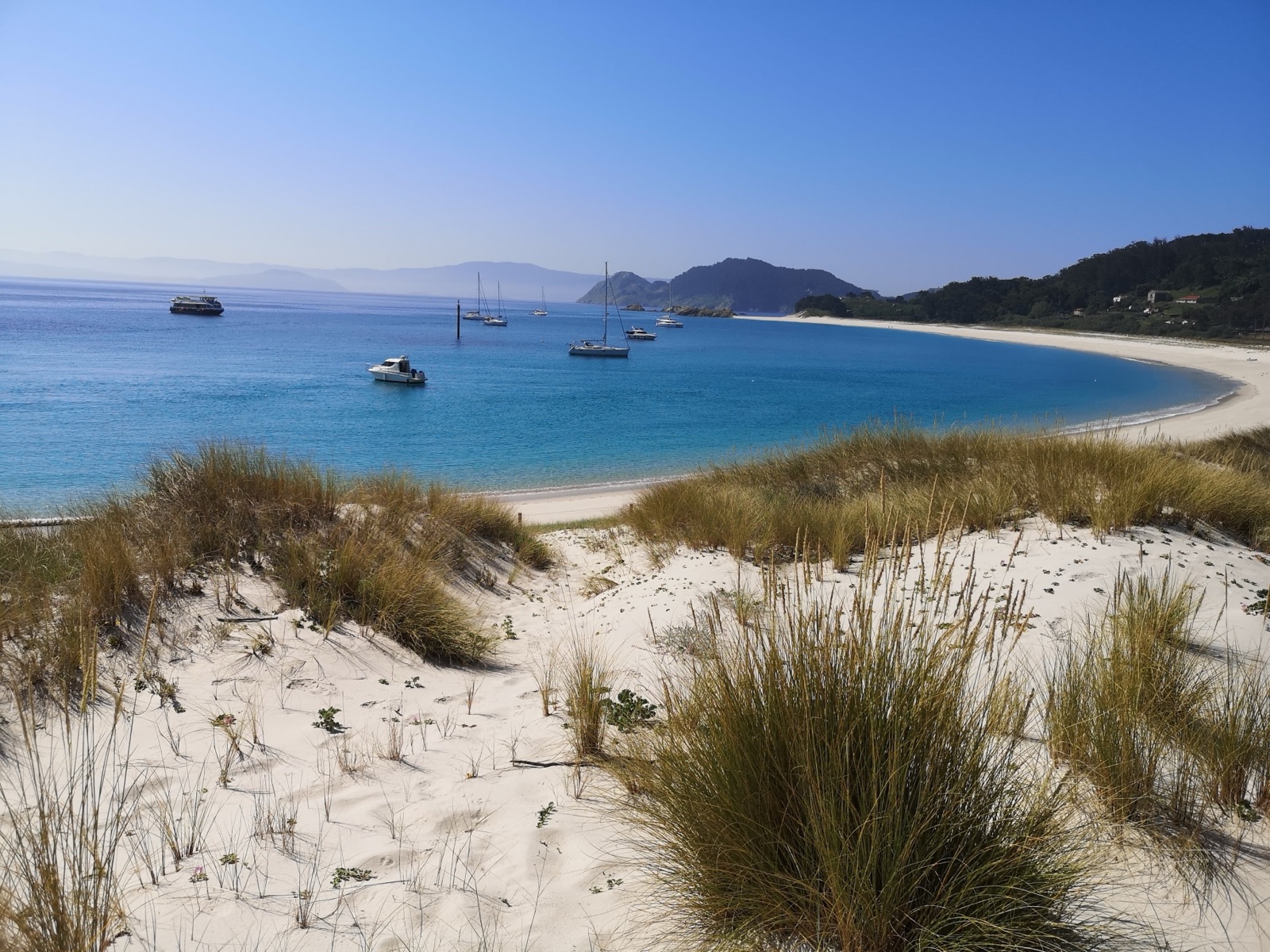
At the mouth of the Vigo estuary, a line of granite islands shelters the Galician coast from the Atlantic. The Cíes Islands are wild and almost uninhabited, with white-sand beaches, clear water, pine woods and cliffs full of seabirds — and, because they are part of a national park, the number of visitors is strictly limited. In summer you cannot simply turn up at the harbour and get on a boat: you need a free permit first, and on popular days the permits run out well before the boats do.
This guide explains exactly how the permit system works, how to get one, where the ferries leave from and how long they take, what they cost, what changes out of season, and the easiest ways to visit on a day trip.
The islands at a glance
- The archipelago has three islands, Monteagudo (north), do Faro (middle) and San Martiño (south); the first two are joined by a breakwater and by the sands of Rodas beach.
- The islands lie 14.5 km from Vigo, about three-quarters of an hour by boat.
- Declared on 1 July 2002, the national park covers 8,480 ha (7,285.2 ha of sea and 1,194.8 ha of land); the Cíes archipelago has 2,658 ha of sea and 433 ha of land.
- Rodas is the most visited beach in Galicia, and in February 2007 The Guardian named Rodas ‘the best beach in the world’.
Day visitors explore the two northern islands, Monteagudo and Faro, on foot, around Rodas beach where they meet. San Martiño, the southern island, lies across a strait: Monteagudo and San Martiño are separated by a strait of about 500 m, the Freu da Porta.
The permit: what you need to know
When you need one
In high season (Holy Week and 15 May–15 September) each visitor needs a free permit from the Xunta before travelling, because the islands have a daily visitor limit. The permit is issued by the regional government, not by the ferry companies, and you must have it before you can buy a ferry ticket.
The daily quota
The quota is 1,800 visitors a day for the Cíes Islands (1,300 for Ons). Once a day’s places are gone, no more permits are issued for that date, whatever the ferries have left. On the permit calendar, green days still have places and red days are full.
It is free
The permit itself is free; you pay only for the boat. Be wary of any website that charges for it.
How far ahead
Permits can be requested up to 90 days ahead and cancelled up to 15 days before the visit. For summer weekends and August, apply as early as you can.
Why the limits exist
The permit system can feel bureaucratic, but it exists for good reasons. Mass tourism began in the 1950s, and the islands suffered for it; protection began in 1980, when Cíes was declared a natural park; it became a Special Protection Area for Birds in 1988, and the national park followed in 2002. The islands are home to 22,000 pairs of yellow-legged gulls, the largest colony in the world, as well as rare dune plants and rich sea life. Limiting the number of people who land each day keeps the beaches, dunes and colonies in good shape, and it also means that, even on a busy day, the islands never feel overrun.
Getting the permit, step by step
- Apply online on the Xunta’s permit website, choosing the Cíes Islands, your date and the number of visitors. Up to 10 places can be booked per application, giving each visitor’s name, ID number, sex and date of birth.
- Receive your pre-booking code. Applying online gives a provisional pre-booking code valid for two hours, in which you must buy a ferry ticket from an approved operator; the final permit then arrives by email.
- Buy your ferry ticket within those two hours, using the code. If the code expires, you have to start again.
- Keep the final permit. The permit is personal and non-transferable, with a QR code and each visitor’s name.
- On the day, carry the permit printed or on your phone, as it is asked for at boarding, and collect your ticket at the ferry office before boarding. Go to the ferry ticket office 30 minutes before departure to print your ticket.
Tips for the permit
- Have everyone’s ID details ready before you start; the two-hour window passes quickly.
- Book the ferry immediately after receiving the code.
- Check your spam folder if the final permit email does not arrive.
- Plan an alternative date if your first choice shows red on the calendar.
Camping on the islands
If you are staying at the campsite, the process is simpler: if you book the campsite, the campsite arranges the permit for your dates. Campsite places are limited too, so book early for summer.
Staying overnight
A night on the islands is a very different experience from a day trip: once the last boat leaves, the beaches empty and the stars come out over the Atlantic. Overnight stays are at the campsite: the campsite is on Faro island, passed on the way to the lighthouse. Remember that fires of any kind are forbidden, as is camping outside the campsite, and that campsite places, like day permits, are limited in summer. Book the campsite first; it then arranges the permit for your dates, and you buy the ferry ticket to match.
Out of season
Outside the high season, the rules change:
- From 15 September to 15 May (except Easter) you do not need to request a permit yourself.
- Outside the high season, visits to Cíes and Ons are made in guided groups. The ferry operator arranges the visit and the permit for its group.
Out-of-season visits are quieter and have a different charm, but boats are fewer and weather-dependent, so check what the operators are offering on your dates. A guided visit also has an advantage of its own: a guide who knows the islands’ history, birds and plants, and who can explain what you are seeing along the paths. Dress for changeable Atlantic weather, and expect a smaller, calmer group than on a summer ferry.
The ferries
Where they leave from
Boats to the Cíes leave from Vigo, Cangas, Baiona, Sanxenxo and Portonovo. Vigo and Cangas, on opposite shores of the estuary, are the main departure points.
How long it takes
Crossings take about 40 minutes from Vigo, 35 minutes from Baiona and about an hour from Cangas (calling at Vigo), Sanxenxo and Portonovo. The crossing takes you out along the estuary, with the islands growing on the horizon.
What it costs
Fares vary with the season and the operator. As an example, Nabia’s return fares from Vigo or Cangas are €25 for adults at Easter, €27 in July, €29 in August and September and €24 at other times; children aged 4 to 12 pay €12 (€10 off-peak); children under 4 travel free; booking fees are extra.
The round-trip ferry
Round-trip boat from Vigo or Cangas. The return boat to the islands from Vigo or Cangas in the Vigo estuary — the basic way over, with the day on the islands yours. The whole outing takes about 5–6 hours.
Choosing a departure port
Each port has its advantages, and the right one depends on where you are staying.
- Vigo is the obvious choice if you are staying in the city. The islands lie 14.5 km from Vigo, and crossings take about 40 minutes from Vigo.
- Cangas, on the northern shore of the estuary, suits visitors staying on the Morrazo peninsula; its boats call at Vigo, so the crossing takes about an hour.
- Baiona, to the south, has the shortest crossing, at about 35 minutes.
- Sanxenxo and Portonovo, the resorts of the Pontevedra estuary, are about an hour away by boat, convenient if you are staying on that coast.
Whichever port you choose, the permit rules are the same, and you need the permit before you can buy the ticket.
When to go
- High season (Holy Week and 15 May–15 September) is when most people visit, with the warmest weather and the most boats. It is also when the permit and the daily quota apply, so plan ahead. A first-aid point operates only in high season, at the campsite, and Vigo usually provides beach lifeguards in summer; staff arrive on the first boat and leave on the last.
- July and August are the busiest months; weekends fill first, so aim for a weekday if you can.
- Late May, June and September, at the edges of the high season, are usually in less demand than July and August, though the permit still applies.
- The rest of the year, visits are made in guided groups, the islands are quiet, and the weather is more changeable.
On arrival
When you step off the boat, a few landmarks help you find your way.
- The information hut is the starting point for the main walks, including the Monte Faro route.
- Toilets: public toilets are on the path above the campsite, on the lighthouse route.
- Rest areas: rest areas with stone tables are by O Lago, Nuestra Señora beach and the path to Figueiras beach.
- Viewpoints: the main viewpoints are the Cíes lighthouse, Faro da Porta, the Monteagudo lighthouse, Pedra da Campá and Alto do Príncipe.
Our guide to walks and beaches on the Cíes Islands covers the routes in detail.
Day trips and tours
If you are not staying in Vigo, or want the logistics handled, a tour covers the transport.
Day trip from Santiago de Compostela. Return transport from Santiago and the ferry tickets, with free time on the beaches and the walk to the lighthouse. About 10 hours.
Full-day sailing trip with a skipper. A sailboat from Vigo with a picnic on board, snorkelling and paddleboarding, anchoring off the islands so you can walk to the lighthouse. About 8 hours.
The tours page lists them all with live prices.
Before you board: what to bring
The islands have few services, so pack as for a day in the wild.
- Water. There is no drinking water: the public fountains have no health guarantee, so bring water, though it can be bought at the islands’ eateries.
- Food, or money for the few places to eat on the islands.
- Sun protection; the wind can hide how strong the sun is.
- Walking shoes for the paths to the lighthouse and viewpoints.
- A bag for your rubbish: leaving rubbish of any kind is forbidden.
- A layer, because the Atlantic breeze can be cool even in summer.
What you cannot bring or do
The national park has clear rules, designed to protect a fragile place.
- Pets may not be landed, except guide dogs.
- Only walking is allowed on the paths; bicycles and other vehicles are not.
- Drones and kites need express permission from the national park.
- Fires of any kind are forbidden, as is camping outside the campsite.
- Collecting shells from the beaches or seabed is not allowed.
A sample day
- Morning: collect your ticket at the ferry office 30 minutes before departure, permit ready; take an early boat from Vigo.
- On arrival: walk to the information hut near the jetty and set off on the Monte Faro route while it is cool; it is 7 km there and back and takes about 2 h 30 min.
- Lunch: a picnic in one of the rest areas, or at the islands’ eateries.
- Afternoon: relax on Rodas beach and look at the lagoon behind it.
- Late afternoon: the boat back to Vigo or Cangas.
Which option suits you?
- Independent and flexible: get your permit, then the round-trip ferry from Vigo or Cangas, and spend the day as you like.
- Staying in Santiago: the 10-hour day trip, with the ferry tickets included.
- Something special: the 8-hour sailing trip, with snorkelling and paddleboarding.
- Out of season: a guided group visit arranged by the ferry operator.
Practical tips
- Apply for the permit early, especially for July, August and weekends.
- Do not buy the ferry first; the permit comes first.
- Arrive 30 minutes early at the ferry office to print your ticket.
- Check the forecast; the Atlantic can be rough, and boats depend on the sea.
- Take the last boat seriously, and be back at the jetty in good time.
With children
Children love the boat ride, the beaches and the birds. Children aged 4 to 12 pay €12 (€10 off-peak); children under 4 travel free with Nabia. Each child still needs a place on the permit, so include them in your application. Pack plenty of water and snacks, and choose shorter walks for younger children.
Accessibility
Motor vehicles cannot be landed, except wheelchairs, and public toilets are on the path above the campsite, on the lighthouse route. The paths are unpaved and some are steep, so the lighthouse is not suitable for wheelchairs, but the area around the jetty and Rodas beach is flatter. Ask the ferry operator about boarding assistance.
Frequently asked questions
Do I need a permit to visit the Cíes Islands?
In high season — Holy Week and 15 May to 15 September — yes. Each visitor needs a free permit from the Xunta before buying a ferry ticket. The rest of the year, visits are made in guided groups arranged by the ferry operators.
How many people can visit the Cíes Islands each day?
The quota is 1,800 visitors a day.
How long is the ferry to the Cíes Islands?
About 40 minutes from Vigo, 35 minutes from Baiona and about an hour from Cangas, Sanxenxo and Portonovo.
How much is the ferry?
With Nabia, an adult return from Vigo or Cangas costs €24 to €29 depending on the season; children aged 4 to 12 pay €10 to €12, and children under 4 travel free.
Can I take my dog to the Cíes Islands?
No. Pets may not be landed, except guide dogs.
Can I stay overnight on the Cíes Islands?
Yes, at the campsite on Faro island. If you book the campsite, the campsite arranges the permit for your dates; camping anywhere else is forbidden.