The Cíes Islands with Kids: Fares, Family Beaches, Easy Walks, Activities and Camping
The Cíes Islands are one of the best family days out in Galicia: a short boat ride, a calm white beach with summer lifeguards, no cars, easy paths through the woods and a lighthouse walk older children love. Children under 4 travel free on Nabia’s boats, the campsite runs free activities for children aged 4 and over in summer, and a night in a tent turns the day into an adventure. The things to plan for are the permit (every child needs one in high season), water and shade, and the fact that there is no pharmacy on the islands.
At a glance
| What | For children |
|---|---|
| Boat fare (Nabia, from Vigo or Cangas) | Ages 4 to 12: €12 (€10 off-peak); under 4: free |
| Boat fare (Mar de Ons, from Vigo, Cangas or Baiona) | Ages 5 to 12: €12; under 5: free |
| Permit (Easter and 15 May to 15 September) | Free, needed for each visitor, children included |
| Campsite children’s activities | Free, ages 4 and over, summer |
| Guided snorkelling | Over 10, able to swim |
| Guided kayaking | 12 and over, able to swim |
| Stargazing at the campsite | Free for under-10s |
| Camping, own tent (2026, per night) | Ages 3 to 10: €7.90 low season, €8.90 high season |
Is the Cíes a good trip for children?
Mostly, yes. In its favour:
- The crossing is short. Crossings take about 40 minutes from Vigo, 35 minutes from Baiona.
- No traffic. Only walking is allowed on the paths; bicycles and other vehicles are not. Children can walk freely on the main paths.
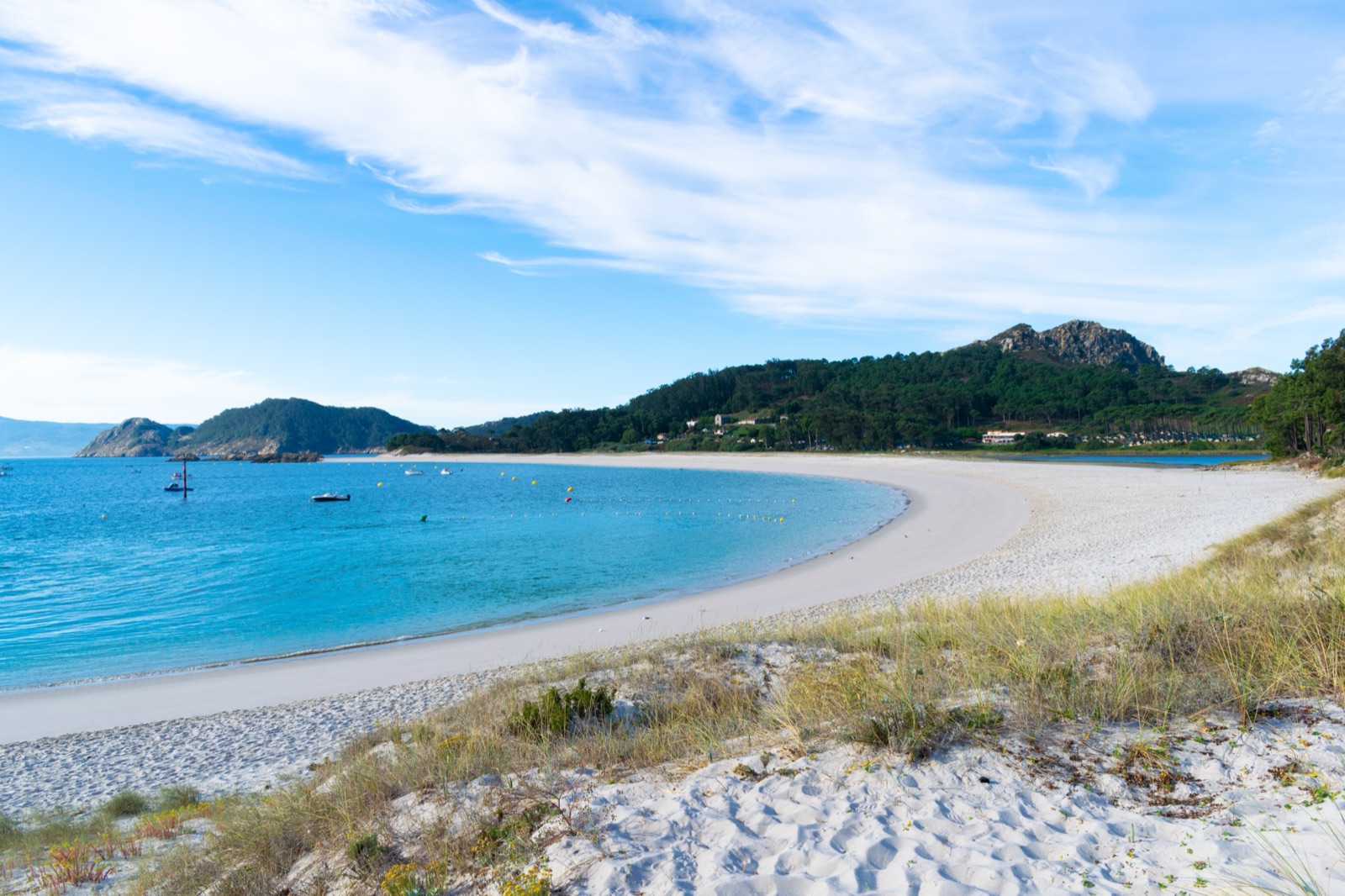
- A beach made for families. Rodas is long, wide and sheltered, with lifeguards in summer.
- Wildlife up close. Gulls, shags, lizards and rock pools are a constant source of interest.
The challenges:
- Little shade on the beaches, and strong sun.
- No drinking water from the fountains.
- A day that depends on boat times, which means long days for small children.
- Steep cliffs on the western side and at the lighthouse.
With a bit of planning, none of those is a reason not to go.
Boat fares for children
Each ferry company sets its own child fares. Two examples:
- Nabia’s return fares from Vigo or Cangas: children aged 4 to 12 pay €12 (€10 off-peak); children under 4 travel free; booking fees are extra.
- Mar de Ons lists Cíes fares from Vigo, Cangas and Baiona of €27.50 for adults and €12 for children aged 5 to 12, with under-5s free.
So for a family with a three-year-old and a five-year-old, the cheapest operator depends on the ages. The getting there guide compares the ports and fares.
The permit for families
In high season (Holy Week and 15 May–15 September) each visitor needs a free permit from the Xunta before travelling, and that includes children and babies. Plan for this:
- Up to 10 places can be booked per application, giving each visitor’s name, ID number, sex and date of birth, so have the children’s details ready.
- Applying online gives a provisional pre-booking code valid for two hours, in which you must buy a ferry ticket from an approved operator; buy the whole family’s tickets in one go.
- Permits can be requested up to 90 days ahead, and on popular summer days they run out, so book early if you are tied to school holidays.
Out of season (from 15 September to 15 May, except Easter), no permit is needed and visits are made in guided groups.
The best beaches for children
The archipelago has nine beaches in all, mostly on the sheltered eastern side facing the estuary.
- Rodas is the family favourite: 1.3 km long and 60 m wide, a few minutes from the jetty, with the restaurants, toilets and beach lifeguards that Vigo usually provides in summer. The sand is fine and white, and the water is usually calm.
- Nosa Señora (Nuestra Señora), a small, sheltered bay 140 m long and 20 m wide, is recommended by the campsite when the wind is from the north.
- Bolos, also called Conchas, at the end of Rodas, is named for its many shells; children can look, but collecting shells from the beaches or seabed is not allowed.
Figueiras is a nudist beach, worth knowing if you are choosing where to spread your towel.
The water is cold for small children, even in August, so keep swims short and have a towel and a dry layer ready. The snorkelling, kayaking and diving guide has more on the sea.
Walks for small legs
All the walks start near the jetty, at the information hut, and the first part is flat.
- To the lake and the interpretation centre. From the information hut the path crosses the dyke to Faro island, past the lake and the campsite, reaching the nature interpretation centre in about 20 minutes. It is flat, shaded in places, and has the lagoon to look at. The interpretation centre has an exhibition on the park’s values, and one of the old stone tombs found on the island.
- To the bird observatory. Halfway up, a detour leads to the Pedra da Campá, a rock pierced by salt-laden Atlantic winds; 100 m further on is the bird observatory, about 50 minutes from the start. This is a good turning point for younger children: a real climb, a strange rock and the noise of the gull colony.
- To the lighthouse. The Monte Faro route is 7 km there and back, takes about 2 h 30 min, is of medium difficulty and climbs 175 m. Children who are used to walking usually manage it with breaks, snacks and water; judge by what your own children walk at home. The final zigzag is steep and exposed, and at the lighthouse, 175 m cliffs drop away below you: hold small hands.
The walks and beaches guide has all the routes. Beyond the flat stretch near the jetty and the lake, the climb to the lighthouse is steep and rough, so a child carrier is easier than a pushchair.
Wildlife to look for
Turn the day into a nature hunt:
- Gulls: 22,000 pairs of yellow-legged gulls form the largest colony in the world. From the observatories you can watch them nesting on the cliffs without disturbing them.
- Shags: 2,500 pairs of shags also breed here, dark seabirds that dive for fish.
- On land: rabbits, hedgehogs and otters are the only wild mammals with a real presence, and lizards sun themselves on the rocks.
- In the water: anemones, sea urchins and small fish in the sheltered rocks, and, from the boat, perhaps dolphins: dolphins, whales and sea turtles regularly visit the waters around the islands.
Teach children not to chase or feed the gulls; they are bold around food.
Activities for children
Free activities at the campsite
Free children’s activities run at weekends in June and daily from 20 June to 6 September, 10:00–12:30 and 19:00–21:00. Outdoor games and creative workshops teach respect for nature and teamwork.
- They are for ages 4 and over, are not a crèche, and parents must stay nearby but outside the activity area.
- Ask at campsite reception which sessions are running and whether children on a day visit can join.
Snorkelling and kayaking
- Snorkelling: snorkellers must be able to swim and be over 10; 10- to 15-year-olds go with an adult. The guided outing provides a wetsuit, safety buoy, fins, mask and snorkel, and costs €30 in June and €35 from July to September.
- Kayaking: kayakers must be able to swim and be at least 12; 12- and 13-year-olds go with an adult, and 14 to 18-year-olds may go alone with a signed form. The double kayaks are stable, and a guide follows in a support dinghy.
Stargazing
The park is a Starlight destination; on clear nights the campsite runs a stargazing activity of about one hour, for €10, free for under-10s, booked at reception. Children under 10 join the stargazing for free and must be with an adult.
Camping with children
A night on the islands is the highlight of many family holidays in Galicia. The campsite is on Faro island, 800 m from the information hut.
- Own tent (2026): an adult pays €10.90 a night in low season and €11.90 in high season; children aged 3 to 10 pay €7.90 a night in low season, and €8.90 in high season.
- Hired tent: the supplement is €7.40 a night for a child aged 3 to 10 and €10.40 for ages 11 to 17; babies up to 2 stay free. Travel cots cost €10 for the whole stay. A child added to a hired tent needs their own mattress.
- Quiet hours are 01:00 to 09:00, which helps small sleepers.
- For camping with children the campsite advises warm clothing for the nights, high-factor sunscreen and insect repellent.
The camping guide explains booking, the permit and the rules.
Food for children
- The campsite restaurant has children’s menus and caters for vegans, vegetarians and allergies.
- Restaurante Rodas is self-service, with a menu suited to families.
- The campsite shop and snack bar sell ice creams, cold drinks and snacks in season.
- On busy days, bring a picnic anyway: lunch queues are long, and hungry children do not wait well.
The food and packing guide covers each place to eat.
Babies and toddlers
The Cíes work well with the very young, as long as you treat the day as a beach day rather than a hiking day.
- Fares and permits. Babies travel free on the boats, but still need a place on the permit in high season.
- Stay near Rodas. The jetty, the toilets, the restaurants and the lifeguards are all within a short walk, and public toilets are on the path above the campsite, on the lighthouse route.
- Bring shade. A small beach shelter or a parasol makes a big difference on the open sand; the woods behind the beach are the other escape from the sun.
- Nap on the boat. An early boat out and an afternoon boat back fit a toddler’s day better than the last sailing.
- Camping with a baby is possible: babies stay free in the hired tents, and travel cots can be hired for the stay.
Teenagers
Older children get the most out of the islands’ bigger adventures.
- The full lighthouse walk, and the cliffs and views at the top.
- Kayaking from 12, and going without a parent from 14 with a signed form.
- Snorkelling among octopus and anemones.
- A night at the campsite, with the stargazing and a sunset over the Atlantic.
- Photography: the viewpoints and the bird observatories are some of the best in Galicia.
Choosing a port with children
- Vigo has the most sailings and the shortest walk from the city centre to the boats, but public parking is hard to find, especially in July and August; private car parks by each quay cost about €2 an hour or €15 a day.
- Cangas suits families staying on the Morrazo peninsula; its boats call at Vigo, so the crossing is longer.
- Baiona has the shortest crossing, about 35 minutes, useful for children prone to seasickness.
- Moaña, where Nabia also sells Cíes boats, has free parking on the quay itself, a help if you are driving with a car full of beach gear.
Arrive early: go to the ferry ticket office 30 minutes before departure to print your ticket, and allow time to park.
Keeping everyone safe
- First aid: a first-aid point operates only in high season, at the campsite; the campsite also has a nursing service. There is no pharmacy on the island, so bring children’s painkillers, plasters, sun cream and any medicine you need.
- Lifeguards: in summer on Rodas, staff arrive on the first boat and leave on the last.
- Sun and wind: the islands are windy, with a lot of salt in the air, which together with the sun makes dehydration likely. Hats, sun cream and plenty of water.
- Water: there is no drinking water from the fountains; bring it or buy it.
- Cliffs: stay on the paths and hold hands near the edges, especially at the lighthouse and the viewpoints.
- Boats: sailings can be cancelled in bad weather; have a plan B for a rough day.
Rules to explain to children
The national park’s rules are easy to turn into a game of “look, don’t take”:
- No shells. Collecting shells from the beaches or seabed is not allowed.
- No nets. Park rules forbid carrying children’s shrimping nets, weapons, harpoons or spearguns, so leave the fishing net at home.
- Stay on the paths, and off the dunes: the dunes around Rodas are a conservation zone in recovery.
- Take all rubbish home: leaving rubbish of any kind is forbidden.
- No pets: pets may not be landed, except guide dogs.
- No drones or kites without permission from the park.
What to pack for children
- Hats, sunglasses and high-factor sun cream.
- Plenty of water and snacks.
- A warm layer and a windproof for the boat.
- Trainers for the walk, and beach shoes.
- Swimsuit, towel and a change of clothes.
- A small first-aid kit.
- Binoculars and a notebook for a wildlife list.
- A bag for rubbish.
A sample family day
- Morning: an early boat, then the flat walk past the lake to the interpretation centre.
- Late morning: on to the Pedra da Campá and the bird observatory, or the full lighthouse walk with older children.
- Lunch: a picnic at the rest area by O Lago, or the family menu at Restaurante Rodas.
- Afternoon: Rodas beach, with lifeguards on duty in summer.
- Late afternoon: the boat back, or, better, a night at the campsite and the stargazing after dark.
The whole round trip on the basic ferry takes about 5–6 hours. If you would rather someone else organised the day, the tours page has the round-trip ferry and a full-day sailing trip.
Frequently asked questions
Do children need a permit to visit the Cíes Islands?
Yes, in high season (Easter and 15 May to 15 September) every visitor needs the free Xunta permit, children and babies included.
Do babies travel free on the boats?
On Nabia’s boats, children under 4 travel free; Mar de Ons carries under-5s free.
Is the lighthouse walk suitable for children?
For children used to walking, yes, with breaks. It is 7 km there and back with a 175 m climb; younger children can turn back at the bird observatory.
Are there activities for kids on the Cíes?
Yes, in summer: free children’s activities at the campsite for ages 4 and over, snorkelling from age 10, kayaking from 12 and stargazing, free for under-10s.
Can you take a pushchair to the Cíes Islands?
Near the jetty and the lake the paths are flat; for the steep, rough climb to the lighthouse a child carrier is easier.