Places
Isla de Ons: Permits, Ferries, Beaches and Walks, and Ons vs Cíes
Isla de Ons is the Cíes Islands’ neighbour in the Atlantic Islands national park, the only island in the park where people still live, and the other one with a summer permit system. It sits at the mouth of the Pontevedra estuary, the next estuary north of Vigo’s, and belongs to the municipality of Bueu. In summer it works exactly like the Cíes: from Holy Week and between 15 May and 15 September you need a free permit from the Xunta before a ferry company will sell you a ticket, and the daily quota for Ons is 1,300 visitors. Boats leave mainly from Bueu, Portonovo and Sanxenxo, and the crossing takes about 40 minutes.
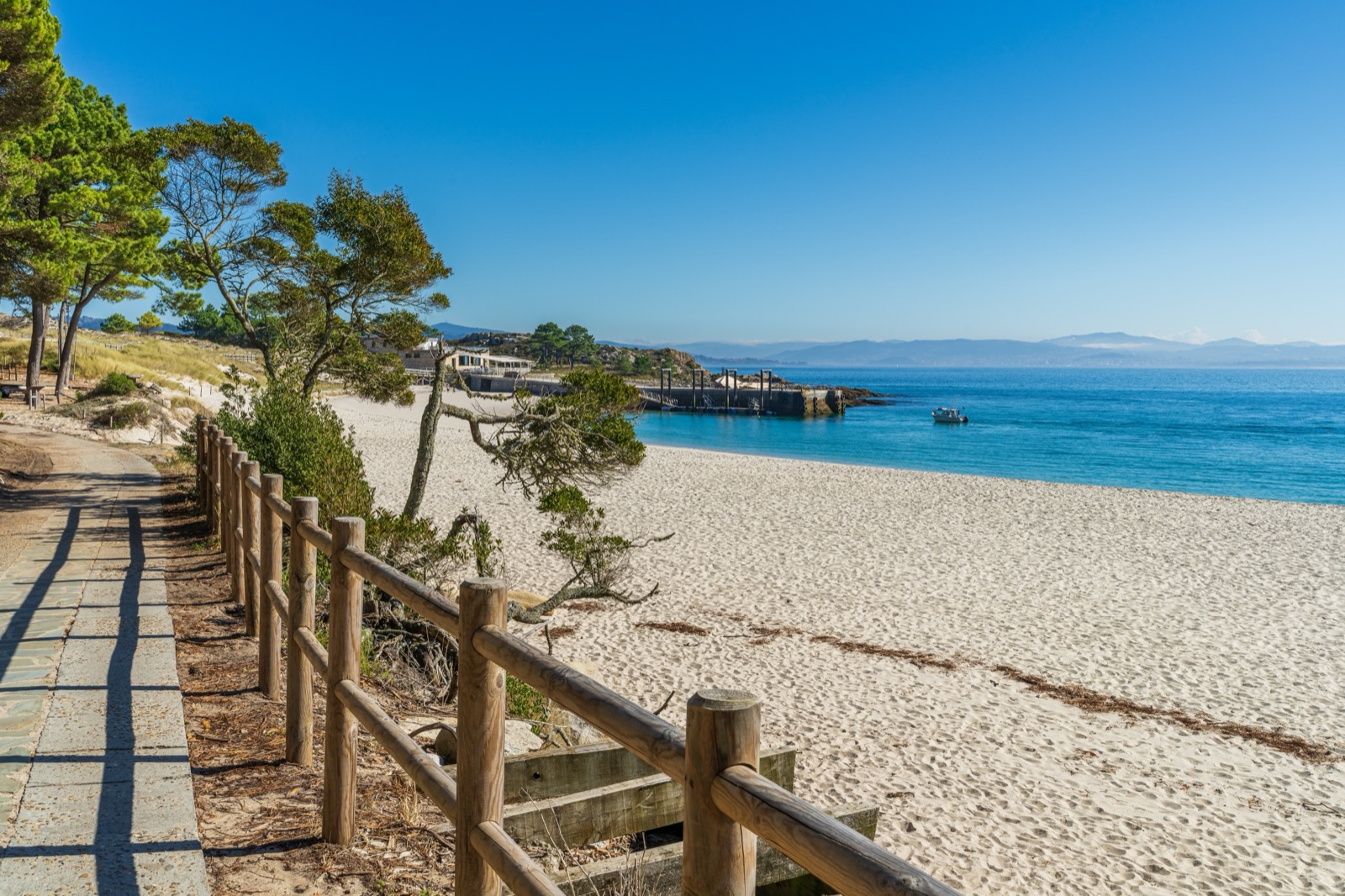
What you find when you step off the boat is different from the Cíes. There is a small village with restaurants and rooms, a working lighthouse on the highest point, four waymarked circular walks, a string of sandy beaches on the sheltered east coast and, on the Atlantic side, the Buraco do Inferno, a hole in the cliffs that drops 40 m to the sea. This guide covers the permit, the boats and fares, the walks and beaches, where to stay, a little history, and how Ons compares with the Cíes.
Ons at a glance
- Two islands. Ons, the larger and still inhabited, and Onza, smaller, whose land (except its beaches) is a reserve zone.
- Size. The park gives 470 ha of land and 2,171 ha of sea. The Cíes archipelago, for comparison, has 433 ha of land.
- Municipality. Ons belongs to Bueu, on the Morrazo peninsula.
- Protection. Ons has been a Special Protection Area for Birds since 2001 and part of the national park since it was declared on 1 July 2002.
- People. The park describes Ons as the only one of the Atlantic Islands with a stable population, of fewer than 20 people. The council of Bueu puts the year-round figure at only five.
Where Ons is, and how it relates to the Cíes
Ons is not part of the Cíes. It is a separate archipelago of the same national park, further north, guarding the Pontevedra estuary in the way the Cíes guard Vigo’s. From the Fedorentos viewpoint you look south across Onza to the Cíes, and the two groups are clearly neighbours, but they are reached from different harbours. Boats to the Cíes sail from Vigo, Cangas and Baiona, as well as from the Sanxenxo coast; boats to Ons sail mainly from Bueu, Portonovo and Sanxenxo, with some from Vigo.
Treat them as two separate day trips: from Vigo, the Cíes are simpler; from Sanxenxo, Portonovo or the Morrazo peninsula, Ons is on your doorstep.
The permit: the same system as the Cíes
Ons uses the same Xunta permit system as the Cíes; our guide to visiting the Cíes Islands walks through it step by step. What matters for Ons:
- When you need it. In high season, meaning Holy Week and 15 May to 15 September, each visitor needs a free permit from the Xunta before travelling, because the islands have a daily visitor limit.
- The quota. 1,300 visitors a day for Ons. Once a date is full, no more permits are issued for it.
- The two-hour window. Applying online gives you a provisional pre-booking code valid for two hours, in which you must buy a ferry ticket from an approved operator. The final permit then arrives by email.
- On the day. Carry the permit printed or on your phone, as it is asked for at boarding.
- Cancelling. For Cíes and Ons trips, the permit can be cancelled up to 15 days before the visit, according to Nabia’s help pages.
- Letting the operator do it. Nabia says it will arrange the permit free of charge if you book with it by phone.
- Campers. If you book the campsite, the campsite arranges the permit for your dates.
Out of season
From 15 September to 15 May, except Easter, you do not need to request a permit yourself. Outside the high season, Ons can only be visited in an organised group with a guide, arranged through the ferry companies. The park caps visitors at 250–450 a day in this period, and each guide must be accredited by the national park and may take no more than 25 people. Nabia says its low-season ticket to Ons includes a guided walk.
Ferries to Ons
Ports and crossing times
The park says the companies serving Ons are usually based in Bueu, Sanxenxo and Portonovo, and that they set their routes and timetables each season. Mar de Ons lists departures to Ons from Vigo, Bueu, Sanxenxo, Portonovo, Combarro and Pontevedra.
- Bueu, Portonovo and Sanxenxo: about 40 minutes with Mar de Ons; Nabia gives the same for Bueu and Portonovo.
- Combarro: about 50 minutes with Mar de Ons.
- Vigo or Pontevedra: a little over an hour with Mar de Ons.
Boats sometimes call at another port on the way. Nabia warns that its boats may stop elsewhere for up to 15 minutes, and that timetables can be changed or cancelled for weather or operational reasons. Check the day’s sailings before you leave your accommodation.
What it costs
As an example, Nabia’s fare table for Ons (checked in September 2026) gives these adult returns:
- From Bueu: €16 at Easter and the rest of the year, €17 in July, August and September up to 15 September.
- From Portonovo: €19.
- From Vigo: €27, a service listed only in the July to mid-September column.
- Children aged 4 to 12 pay €10 from Bueu. Booking fees are not included.
Fares change by season and operator, so check before you book.
Boarding
Nabia starts boarding 15 minutes before departure and asks passengers to print their tickets at the ticket office first. Mar de Ons suggests going to the ferry ticket office 30 minutes before departure to print your ticket.
Arriving: the pier, Curro and the basics
You land at the pier on the east coast. The national park’s information hut stands beside it, and all the signposted trails start there, so it is the natural first stop for a map and a word with the park staff.
Just uphill is Curro, the main village of Ons, where most of the services are.
- Food. Ons has three restaurants, all in the Curro area: Casa Checho, Casa Acuña and El Pirata de Ons. Their opening depends on the ferry service, so do not count on them outside summer. Casa Acuña was founded in 1945 by Jesús Acuña.
- Water. There is no drinking water: the public fountains have no health guarantee. Bring water with you; it can also be bought at the islands’ eateries.
- Health post. A daytime health post operates only in the summer months, usually also at Easter.
- Toilets. The public toilets are next to the health post, past the visitor centre.
- Rest areas. There are three shaded rest areas with tables and benches: by Area dos Cans beach, by As Dornas beach and by the campsite.
The beaches
The beaches of Ons face east, towards the estuary, and are sheltered from the open Atlantic. Nabia counts five sandy beaches on that side.
- Melide. The park’s route guide calls it the largest and most beautiful beach on the island of Ons. It keeps a naturist tradition, and it is about half an hour’s walk from the start of the North route.
- As Dornas. The small beach opposite the information hut, named after the old boats the islanders used.
- Area dos Cans. The most central and busiest beach. On an islet just off it is an anthropomorphic tomb that the park associates with a lost medieval monastery.
- Canexol and Pereiró. Further south along the South route; Pereiró is the southernmost.
The water is cold. The park says it is usually about 15 degrees in summer, and advises a simple wetsuit if you plan to snorkel. Collecting shells from the beaches or seabed is not allowed anywhere in the park.
The four waymarked walks
Ons has four signposted circular trails, each marked in its own colour, and all of them start at the information hut. Walking is allowed only on the colour-marked paths. Because the island is inhabited, there are many other tracks, and the park warns that it is easy to stray into restricted areas or miss your boat, so follow the waymarks.
South route (green)
The South route is a 6.2 km circuit of about 2 h 30 min, with a maximum climb of 86 m. It passes Area dos Cans and Canexol, reaches the Fedorentos viewpoint in about 45 minutes and the Buraco do Inferno at about 1 h 30 min, then follows the west coast to the inlet of Caniveliñas before returning to Curro. Fedorentos is the best-known viewpoint on Ons, looking south to Onza, the Cíes Islands and the nearest mainland. If you only have one walk in you, make it this one.
North route (blue)
The North route is an 8.1 km circuit of about 3 h, with a maximum climb of 100 m. It heads north to Melide, then climbs the west side past the lighthouse and back down by Caniveliñas. A 15-minute detour leads to the Punta Centolo viewpoint, but Punta Centolo is a breeding area for shags and yellow-legged gulls, so access is restricted from 15 February to 31 July. Look out along the way for Cytisus insularis, a broom so far described only on Ons and Sálvora.
Lighthouse route (yellow)
The Lighthouse route is a 4 km circuit of about 1 h 30 min, with a maximum climb of 120 m. It climbs from Curro through the fields and houses of the east side to the Ons lighthouse, which stands at the highest point of the island and has worked without interruption since 1926. Its lantern stands 128 m above sea level. You cannot enter the lighthouse compound without express permission; the path skirts it. The park’s route guide adds that, with Sálvora’s, it is one of the few lighthouses in Spain still attended by keepers. The area around it has fine views over the Pontevedra and Arousa estuaries. On the way back you pass Caniveliñas, where the island is only 350 m wide.
Castelo route (red)
The Castelo route is a 1.1 km circuit of about 40 minutes, with a maximum climb of 33 m, and the obvious choice with small children or a short wait for the boat. It starts at As Dornas and follows the coast north to the Castelo viewpoint, about 15 minutes from the information hut, where only the ruined walls of an old fortification remain. From there you look over the east coast and along to Melide.
Guided and self-guided walks
The park’s guided interpretive walks on Ons in summer are free; you sign up in advance at the information stands on the island. There is also a self-guided route, “The names of the island”, which can be walked with a downloadable guide from the park’s website.
The Buraco do Inferno
The Buraco do Inferno, or Burato do Inferno, is the best-known sight on Ons. Sea and wind erosion formed a granite sea cave whose roof collapsed, leaving a hole that connects, 40 m down, with the cave’s mouth at sea.
The name comes from the belief that it was an entrance to hell where the cries of lost souls could be heard. The park’s explanation is more down to earth: the cries came from seabirds nesting in the cave. Guillemots once nested there, and their Iberian populations are now extinct. The same story played out on the Cíes, where 400 pairs of Iberian guillemots were counted in 1960 and the species is now almost extinct on the islands, as our guide to the Cíes Islands’ nature and history explains.
The hole is on the South route, about 1 h 30 min from the start. Stay on the marked path around it.
A short history of Ons
- Bronze Age. The best-known castro on Ons, still unexcavated, lies above the Canexol quarter and is called Castelo dos Mouros.
- First record. Ons first appears in a document in 899, when King Alfonso III gave “Isla Aones” to the cathedral chapter of Compostela.
- Corsairs. From the late sixteenth century English corsairs and pirates harried the island, until the islanders fled to the coast in the eighteenth century.
- Resettlement. In 1810 the provincial defence board decided to fortify Ons, which allowed the island to be resettled.
- Salt and fish. Between 1835 and 1840 the first salting factory was set up near the pier, and the islanders made fishing their main livelihood.
- The Riobó years. In 1929 Manuel Riobó bought Ons and set up a company drying and selling octopus and conger eel. The council of Bueu notes that the islanders paid rent to the family and had to sell them all the octopus they caught.
- The State. In 1940 the State expropriated Ons for national defence.
- Peak and decline. Ons had almost 500 inhabitants at the end of the 1950s; the island then emptied progressively in barely 20 years.
- Protection. Ons was transferred to the Xunta de Galicia in 1982 and joined the national park on 1 July 2002.
Staying overnight
A night on Ons means seeing the island after the day boats have gone.
- Camping. Camping Isla de Ons is at Chan da Pólvora, 1 km from the pier up the concrete track that leads to the lighthouse. It has room for a maximum of 276 visitors, with toilets and hot showers, a laundry, a café and a reception. If you book the campsite, it arranges the permit for your dates.
- Rooms. Casa Acuña has a guesthouse with double rooms and apartments.
Fires of any kind are forbidden, as is camping outside the campsite.
Ons or the Cíes?
Same park, same permit; the choice comes down to where you are staying and what you want from the day.
- Getting there. The Cíes are about 40 minutes from Vigo and 35 minutes from Baiona; Ons is about 40 minutes from Bueu, Portonovo or Sanxenxo.
- Numbers. The Cíes allow 1,800 visitors a day, Ons 1,300.
- Character. The Cíes are almost uninhabited, with Rodas beach and its lagoon as the centrepiece. Ons has a village, restaurants and rooms, and feels lived in.
- Walking. The Cíes have one classic climb, the Monte Faro route (7 km there and back, climbing 175 m). Ons has four circuits from 1.1 km to 8.1 km, so it is easier to match a walk to your time and legs.
- Beaches. Rodas is the famous one; on Ons, Melide is the prize.
If you have time, do both on separate days. The Cíes are covered in our guide to walks and beaches on the Cíes Islands.
Tours from Vigo
The trips listed on this site go to the Cíes, not Ons, and suit visitors based in Vigo: the round-trip boat from Vigo or Cangas (about 5–6 hours in all) or the full-day sailing trip with a skipper (about 8 hours). The tours page lists them with live prices. For Ons, book with the ferry companies once you have your permit.
Practical tips
- Permit first, then the boat. The code lasts two hours, so have everyone’s details ready.
- Take an early boat. The South route and a swim at Melide fill a day comfortably.
- Carry water and snacks, especially outside summer, when the restaurants may be shut.
- Check the sailing on the day, as weather can change or cancel timetables.
Frequently asked questions
Do I need a permit to visit Isla de Ons?
Yes, in high season: Holy Week and 15 May to 15 September. Each visitor needs a free Xunta permit before buying a ferry ticket, and the quota is 1,300 a day. The rest of the year, visits are made in guided groups arranged by the ferry companies.
How do I get to the Isla de Ons?
By boat from Bueu, Portonovo or Sanxenxo, which takes about 40 minutes. Mar de Ons also lists departures from Vigo, Combarro and Pontevedra, which take longer.
How much is the ferry to Ons?
As an example, Nabia’s adult return from Bueu is €16 at Easter and the rest of the year and €17 in July, August and September; from Portonovo it is €19. Children aged 4 to 12 pay €10 from Bueu, and booking fees are extra.
What is the Buraco do Inferno?
A collapsed sea cave on the west coast of Ons, whose hole connects 40 m down with the sea. It is on the green South route, about 1 h 30 min from the start.
Can you stay overnight on Ons?
Yes. The campsite at Chan da Pólvora takes up to 276 people and arranges your permit when you book, and Casa Acuña has rooms and apartments.
Is Ons better than the Cíes?
They are different. The Cíes have Rodas beach and the lighthouse climb; Ons is lived in and has more choice of walks. Choose by where you are staying.