Places
Things to Do in Vigo: Old Town, Oysters, O Castro and Cíes Boats
Vigo is the most populated city in Galicia and home to one of the largest fishing ports in the world, and for most visitors it is also the gateway to the Cíes Islands, which lie 14.5 km out at the mouth of its estuary, about 40 minutes by boat. The best things to do in Vigo are close together: the old town, the Casco Vello, with its co-cathedral and market; a plate of oysters on Rúa da Pescadería; the climb up Monte O Castro to a fortress with views to the Cíes; the long city beach at Samil; and the MARCO contemporary art museum, which is free.
Give the city a day and the islands another, and you have the best of this corner of Galicia. This guide covers what to see in Vigo, how to use it as a base for the Cíes, how to get there, and suggested plans for one to three days.
Things to do in Vigo at a glance
- Walk the Casco Vello, from Porta do Sol down to the port.
- Eat oysters on Rúa da Pescadería, better known as Rúa das Ostras.
- Climb Monte O Castro, the highest point in the centre, for the fortress and the view.
- See the co-cathedral, La Colegiata, the old town’s Neoclassical church.
- Visit MARCO, the contemporary art museum in the former city jail; entry is free.
- Swim or stroll at Samil, the city’s longest beach.
- Take the boat to the Cíes from the Estación Marítima.
- Come back at Christmas for the lights.
The Casco Vello: Vigo’s old town
The old town runs downhill from Porta do Sol towards the port and the fishing quarter. It is compact; allow a morning, food included.
Porta do Sol
Porta do Sol links the modern centre with the Casco Vello and is where the city gathers for celebrations such as the Reconquista festival and the switching on of the Christmas lights. Look for the Sireno, a sculpture by Leiro that has stood here since 1991 and, as Galicia’s tourism board puts it, seems to be waiting for the right moment to jump into the sea. Around the square stand notable modernist buildings, such as the Pardo Labarta building by Jenaro de la Fuente and the Simeón by Gómez Román.
The co-cathedral of Santa María
Vigo’s co-cathedral of Santa María, popularly known as La Colegiata, is considered one of the best examples of Neoclassical architecture in Galicia. Construction began in 1811 to a design by Melchor de Prado y Mariño, and it was finished in 1836. It holds the Christ of Victory, the city’s most important religious symbol, carried in procession every first Sunday of August. You will find it in the historic centre, near the A Pedra market and Plaza de la Constitución.
The A Pedra market
The A Pedra market is a Vigo classic. Trade here began in the nineteenth century as a provisional market; today it is an outlet for brands at good prices. It is also the landmark for finding the oyster street, which is a few steps away.
O Berbés
Below the old town lies O Berbés, which began as a group of fishermen’s houses outside the city walls. Under its arcades the boats were once left, the nets cleaned and mended and the fish dried. The old fishing quarter is slowly being restored, with buildings rehabilitated for the university and for a hostel for pilgrims on the Portuguese coastal Way.
Oysters on Rúa da Pescadería
Eating oysters in the old town is one of the classic things to do in Vigo. A few steps from the A Pedra market is Rúa da Pescadería, known as Rúa das Ostras, where fresh Arcade oysters are prepared in full view of the public. The street and the lanes of the A Pedra quarter around it are lined with traditional places to eat and drink, so it is easy to make a meal of it.
A few tips:
- Go early if you want space at a table, especially at weekends.
- Ask the price before you order, as it is not always on display.
- Carry on to the port. O Berbés and the waterfront are a short walk downhill.
Monte O Castro: the fortress and the view
If you do one climb in Vigo, make it O Castro. Mount O Castro is the highest point in the centre of Vigo, at 149 metres, with a large pine wood, and it is effectively the city’s central park, with woodland paths, a playground, a skating rink and a small-scale bike circuit.
Layers of history
O Castro is where Vigo began: the hill holds the first known settlement of the city, from when Vigo was Vicus.
- The castro. On the lower slopes is a Castro-culture archaeological site from the third to first centuries BC. On the west slope you can see the remains of the settlement and three reconstructed buildings.
- The fortress. At the top is the seventeenth-century fortress that, with the castle of San Sebastián and the wall, defended the city. Walls, gates and embrasures survive, and the interior has been turned into a garden, with several viewpoints and a pond.
- Relics from the sea. At the entrance to the fortress are anchors and cannons recovered from the estuary.
The view to the Cíes
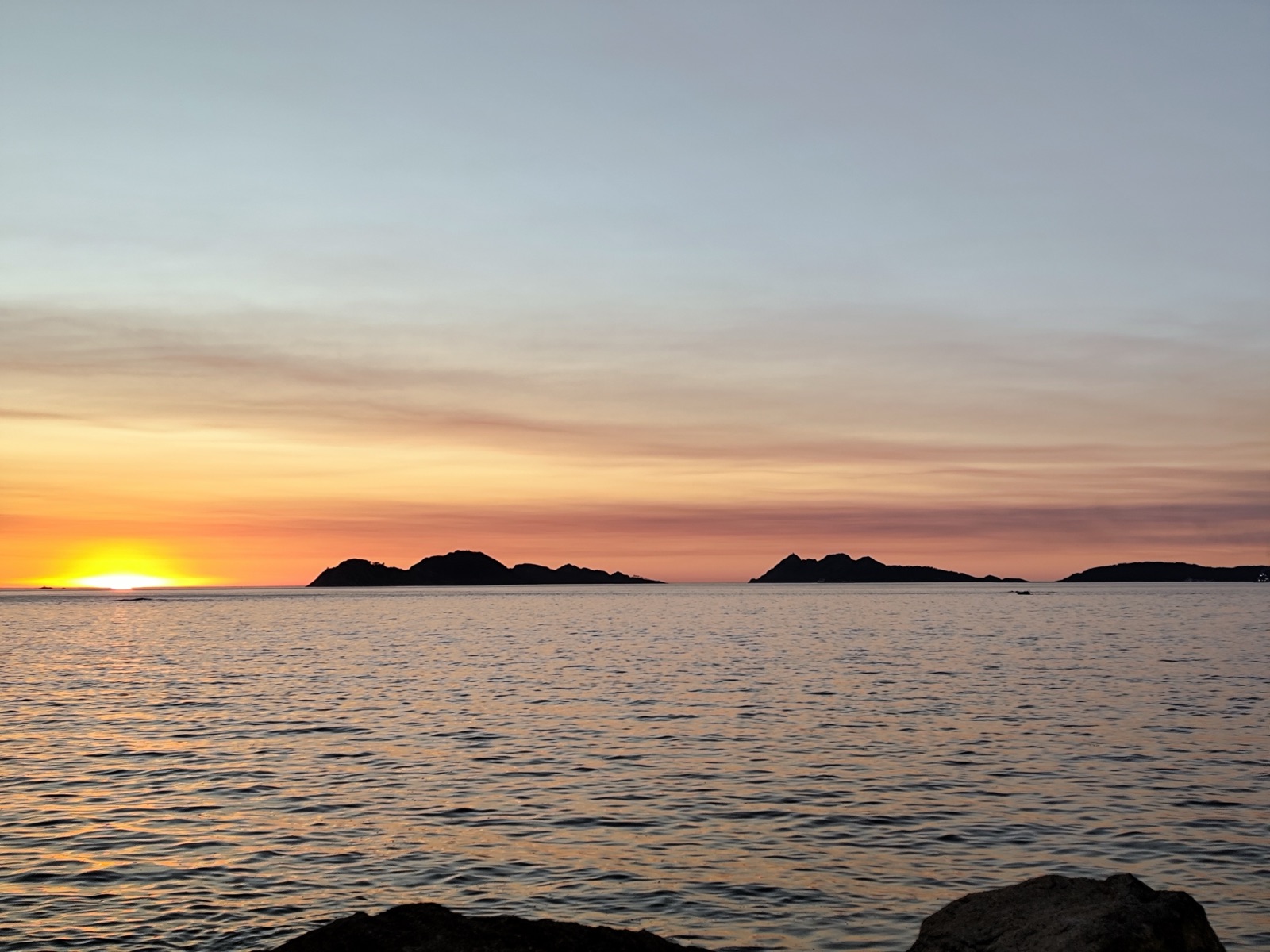
The O Castro viewpoint looks over the city, the hills of O Morrazo on the far shore and the Cíes Islands to the west. On a clear evening it is the best place in Vigo to see the islands you are about to visit, and a good reason to time the climb for late afternoon.
Samil and the city beaches
Samil beach, in Vigo, is 1,700 m long, a sheltered beach of fine sand, and the longest beach in the city. It has a promenade, green spaces, shaded picnic areas, playgrounds and swimming pools, which makes it the easy choice for families. It sits on the southern side of the city, facing the estuary, so plan on a bus, taxi or a long walk from the centre.
For white sand and clear water on a different scale, head out to the Cíes; our guide to walks and beaches on the Cíes Islands covers Rodas and the rest.
MARCO: contemporary art in the old jail
MARCO, Vigo’s contemporary art museum, occupies the city’s former jail and courts, which date from 1880, on the pedestrianised Calle del Príncipe at number 54. The Fundación MARCO, which runs the museum, was set up on 22 October 2002.
- Entry: free.
- Hours: Tuesday to Saturday, holidays included, 11:00–14:30 and 17:00–21:00; Sundays 11:00–14:30.
- Closed: Mondays and the Christmas holidays.
Exhibitions change through the year, so check what is on before you go. It is a good wet-weather plan, and the shopping streets of the centre are right outside.
The Alameda and the centre
In Praza de Compostela, the Alameda was built at the end of the nineteenth century on land reclaimed from the sea and was the city’s first public urban park. Around its central fountain stand three works by Camilo Nogueira and a statue of Méndez Núñez by Agustín Querol. It is a pleasant place to sit between the old town and the port, and a short walk from the Estación Marítima.
Christmas in Vigo
Vigo’s Christmas lights and decorations have become a benchmark throughout Spain, attracting tens of thousands of people. The switch-on is held at Porta do Sol in November; in the season described by the provincial tourism board’s Christmas guide, it took place on 23 November. Lights, markets and activities then run in the towns of the province of Pontevedra until Epiphany. The council announces the switch-on date each autumn, so check it before you book, and expect the centre to be crowded at weekends.
Winter is not island season, though. Outside the high season, visits to the Cíes are made in guided groups arranged by the ferry companies, and sailings depend on the weather.
Vigo and the Portuguese Way
Vigo lies on the Portuguese coastal route of the Way of St James, which comes north along the shore through Baiona. Galicia’s tourism board places Samil beach on the route, and one of the restored buildings in O Berbés is a hostel for pilgrims on the Portuguese coastal Way. If you see walkers with scallop shells on their packs along the seafront, that is where they are heading: north towards Santiago.
When to visit
- Summer (mid-May to mid-September) is island season, with the warmest weather, the most boats and the free permit required. The permit and quota apply from Holy Week and between 15 May and 15 September, so book ahead for July and August weekends.
- The first Sunday of August brings the procession of the Christ of Victory from the co-cathedral.
- November to Epiphany is Christmas-lights season in the city.
- The rest of the year suits city breaks: MARCO, the market and the oysters do not depend on the weather, and the islands can still be visited in guided groups when the sea allows.
Vigo with children
- O Castro has a playground, a skating rink and a small-scale bike circuit, as well as the fortress to explore.
- Samil has playgrounds, swimming pools and shaded picnic areas beside the sand.
- MARCO is free, so a short visit costs nothing if attention runs out.
- The boat to the Cíes is part of the fun: with Nabia, children under 4 travel free and those aged 4 to 12 pay €12 (€10 off-peak). Each child still needs a place on the permit in high season.
Day trips from Vigo
- The Cíes Islands. The obvious one: about 40 minutes by boat, with the Monte Faro lighthouse route (7 km there and back) and Rodas beach (1.3 km long) waiting.
- Baiona. Down the coast, with the Pinta replica, the Monterreal fortress and six Blue Flag beaches. See our guide to Baiona.
- Isla de Ons. The inhabited island of the same national park, a little over an hour by boat from Vigo with Mar de Ons, or about 40 minutes from Bueu or Portonovo.
- Cangas and Moaña. Across the estuary by ferry; Nabia’s Vigo–Moaña crossing takes about 15 minutes.
- Santiago de Compostela. High-speed trains run from Vigo-Urzáiz, so the cathedral city is an easy day out by rail.
Vigo as your base for the Cíes Islands
Where the boats leave from
Boats to the Cíes leave from the Estación Marítima, the maritime station on Calle Cánovas del Castillo, a short walk from the old town. Mar de Ons’s Vigo office there opens Monday to Sunday from 09:00 to 21:00. The islands lie 14.5 km from Vigo, and crossings take about 40 minutes.
The permit comes first
In high season, meaning Holy Week and 15 May to 15 September, each visitor needs a free permit from the Xunta before travelling. The quota is 1,800 visitors a day for the Cíes, permits can be requested up to 90 days ahead, and applying online gives a provisional code valid for two hours in which to buy a ferry ticket. Our guide to visiting the Cíes Islands explains every step.
Fares
- Nabia: return fares from Vigo or Cangas are €25 for adults at Easter, €27 in July, €29 in August and September and €24 at other times; children aged 4 to 12 pay €12 (€10 off-peak); children under 4 travel free; booking fees are extra.
- Mar de Ons: €27.50 for adults and €12 for children aged 5 to 12, with under-5s free.
Both were checked in September 2026; fares change by season, so check before you go. On the day, go to the ferry ticket office 30 minutes before departure to print your ticket.
Before you board: a short checklist
- Water. There is no drinking water on the Cíes: the public fountains have no health guarantee, so bring water, though it can be bought at the islands’ eateries.
- Food and sun protection, and shoes for the lighthouse path.
- A bag for your rubbish: leaving rubbish of any kind is forbidden.
- No pets: pets may not be landed, except guide dogs.
Other boats from Vigo
- To Ons: Mar de Ons sails to Isla de Ons from Vigo in a little over an hour, and Nabia lists a Vigo departure in its July to mid-September fares at €27 for adults. See our guide to Isla de Ons.
- Across the estuary: Nabia’s Vigo–Moaña crossing takes about 15 minutes, and Mar de Ons runs a Vigo–Cangas line, handy for staying on the Morrazo side.
Tours
The round-trip boat from Vigo or Cangas is the basic way over, about 5–6 hours in all with the day on the islands yours. If you are staying in Santiago, the day trip from Santiago de Compostela includes return transport and the ferry tickets, with free time on the beaches and the walk to the lighthouse, in about 10 hours. The tours page lists them with live prices.
Getting to Vigo
- By train. Vigo has two railway stations, Vigo-Guixar and Vigo-Urzáiz. High-speed trains run from Vigo-Urzáiz station to Santiago and A Coruña, and the Celta train links Vigo with Porto in Portugal.
- By air. Vigo airport has seasonal international flights, such as to Paris and London.
- By bus. Regional buses link Vigo with the coast, including Baiona; plan journeys on the Xunta’s public transport site, bus.gal.
Plans for one to three days
One day in Vigo
- Morning: Porta do Sol, the co-cathedral and the A Pedra market.
- Late morning: oysters on Rúa da Pescadería, then O Berbés and the port.
- Afternoon: MARCO, or the Alameda and the shopping streets.
- Evening: up Monte O Castro for the view to the Cíes.
Two days
Add the Cíes: an early boat from the Estación Marítima, the Monte Faro lighthouse route in the morning, Rodas beach in the afternoon, and back for dinner in the old town.
Three days
Add Baiona, down the coast, for the Pinta replica, the walls of Monterreal and the town beaches; in summer, boats also sail from Baiona to the Cíes in about 35 minutes. See our guide to Baiona.
Frequently asked questions
What is Vigo famous for?
Its port, one of the largest fishing ports in the world, its oysters on Rúa da Pescadería, its Christmas lights, and above all the Cíes Islands at the mouth of its estuary. It is also the most populated city in Galicia.
How many days do you need in Vigo?
One day covers the old town, the oysters, MARCO and O Castro. Add a day for the Cíes Islands, and a third if you want to see Baiona.
How do I get from Vigo to the Cíes Islands?
By boat from the Estación Marítima; the crossing takes about 40 minutes. In high season you need the free Xunta permit first, then the ferry ticket.
Is the MARCO museum in Vigo free?
Yes, entry is free. It opens Tuesday to Saturday, 11:00–14:30 and 17:00–21:00, and Sundays 11:00–14:30, and is closed on Mondays.
When are the Vigo Christmas lights switched on?
In November, at Porta do Sol; the council announces the date each autumn. The lights are one of the best-known Christmas displays in Spain and draw tens of thousands of people.