Places
Baiona, Spain: The Pinta, Monterreal Fortress and Boats to the Cíes
Baiona is a small harbour town on the Galician coast, on its own bay just south of the mouth of the Vigo estuary, and it has one claim nobody else can make: on 1 March 1493 the caravel Pinta sailed in with the first news in Europe of the lands Columbus had reached across the Atlantic. Today a replica of the Pinta is moored in the harbour, the walled headland of Monterreal holds a fortress and a parador hotel, and the old town, a string of Blue Flag beaches and a giant granite Virgin on the hill fill the rest of a day.
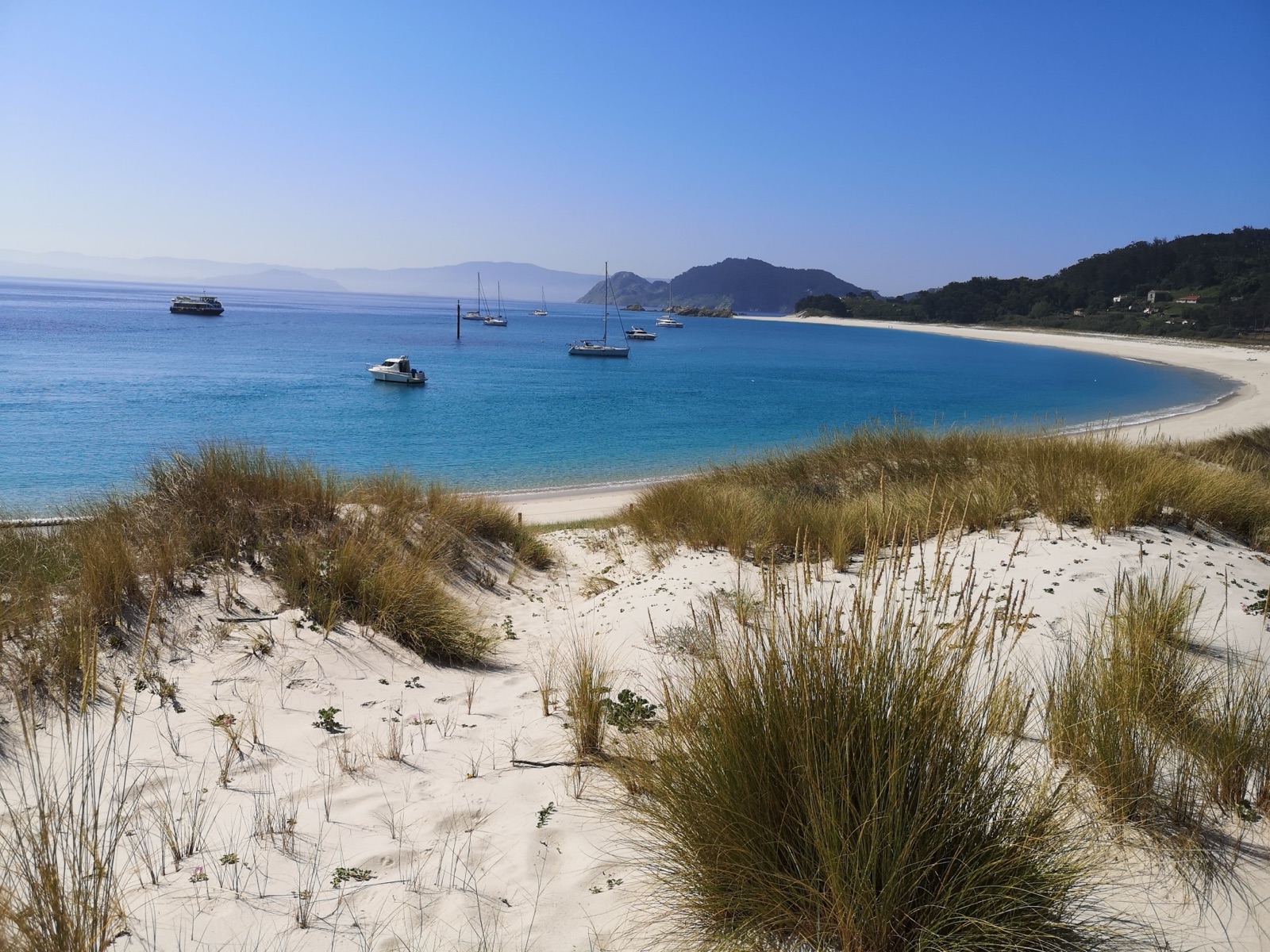
It is also a departure port for the Cíes Islands. Baiona is not part of the islands or of the national park, but in summer boats sail from its harbour to the Cíes in about 35 minutes, the shortest crossing Mar de Ons lists. This guide covers the history, what to see, the Arribada festival, the beaches, and how to use Baiona as a base for the islands.
Baiona at a glance
- Where: on the coast south-west of Vigo, facing the open sea, with the Cíes visible from the hills above the town.
- Why it is famous: the Pinta, captained by Martín Alonso Pinzón, was the first ship of Columbus’s expedition to return, and she reached Baiona on 1 March 1493.
- What to see: the Pinta replica, the Casa de la Navegación museum, the Monterreal fortress, the historic centre and the Virxe da Rocha lookout.
- Beaches: six Blue Flag beaches, including A Ribeira in town and the long sands of A Ladeira.
- The Cíes: about 35 minutes by boat, in the summer season.
- When it is busiest: the Arribada festival on the first weekend in March, and high summer.
Baiona and the Cíes Islands
The boats
Boats to the Cíes leave from Vigo, Cangas, Baiona, Sanxenxo and Portonovo, and crossings take about 35 minutes from Baiona, against about 40 minutes from Vigo. In Baiona, Mar de Ons sails from the Estación Marítima América, and its Baiona office opens daily during Easter week and from 15 May to 15 September, from 09:30 to 15:00. By contrast, its Vigo office opens every day from 09:00 to 21:00. Plan on Baiona sailings being a high-season service and check the operators’ timetables for your date; outside those months, Vigo and Cangas are the ports to look at.
What it costs
Mar de Ons lists Cíes fares from Vigo, Cangas and Baiona of €27.50 for adults and €12 for children aged 5 to 12, with under-5s free (as listed in September 2026). If the departure and return ports differ, it may charge a supplement of between €3 and €9 per person, which matters if you want to sail out from Baiona and back to Vigo. Fares change by season, so check before you go.
The permit comes first
Sailing from Baiona changes nothing about the rules. In high season, meaning Holy Week and 15 May to 15 September, each visitor needs a free permit from the Xunta before travelling, and applying online gives a provisional code valid for two hours in which to buy the ferry ticket. The daily quota is 1,800 visitors for the Cíes, so book early for summer weekends. Our guide to visiting the Cíes Islands covers the permit step by step.
Using Baiona as a base
A night in Baiona before an early boat is an easy way to split the trip: the town in the afternoon and evening, the islands the next day. If Baiona sailings do not fit your dates, the round-trip boat from Vigo or Cangas takes about 5–6 hours in all and leaves the day on the islands yours. The tours page lists all Cíes trips with live prices.
The Pinta and the news from America
The story is told in detail by the town council and the Casa de la Navegación museum.
Columbus’s first expedition sailed with three ships. His own, the Santa María, was popularly called “la gallega” because it was built in Galicia; whether in Pontevedra or Baiona is unclear. The other two, the Pinta and the Niña, were caravels chosen by the Pinzón brothers of Palos de la Frontera.
The Pinta, captained by Martín Alonso Pinzón, was the first ship of the expedition to return; she reached Baiona on 1 March 1493, making it the first port in Europe to hear of the new lands across the ocean. Columbus reached Lisbon three days later.
The Pinta arrived battered, with her captain very ill. According to the council’s account, Pinzón knew Baiona’s port well, and even met his son there, who was returning from the Spanish regiments in Flanders. The ship was repaired and supplied with water and food in Baiona before returning to Palos de la Frontera. She carried exotic products and two Taíno people from the new lands; one of them died because of the harsh voyage. The number aboard is not known exactly; it is estimated at between twenty-three and twenty-seven. Life aboard was very hard: the crew slept in the open or on the cargo, and the diet was poor.
Visiting the Pinta replica
A replica of the Pinta, built for the fifth centenary of the discovery, is permanently moored in Baiona harbour and open to visitors. It was built between 1993 and 1994 at the Astilleros Amado yard in O Freixo, and its interior was restored in 1999, with figures of the crew and of Native Americans and replicas of plants, animals and metals from the New World.
A caravel like the Pinta is a three-masted sailing ship, with square sails on the main and fore masts and a triangular lateen sail on the mizzen. She was steered by hand; the ship’s wheel did not yet exist.
- Opening hours. The provincial tourism board lists the Pinta as closed on Mondays, open Tuesday to Friday 10:00–13:00 and 16:00–19:00, and on Saturday and Sunday 10:30–13:00 and 16:30–19:00. Hours can change with the season, so check before you go.
- Tickets. The entry price includes an audio guide, and a combined ticket for the Casa de la Navegación and the Pinta costs €3.
The Casa de la Navegación
The Casa de la Navegación museum is in the Casa Carbajal in the old town. It covers the port’s history, the town’s founding by Alfonso IX in 1201, maritime trade and the arrival of the Pinta, and it has a virtual-reality headset experience of sailing with the Pinta’s crew as she arrives in Baiona.
- Hours: Tuesday to Saturday, 10:00 to 13:00 and 16:00 to 19:00; closed on Sundays and Mondays.
- Tickets: €2, or €4 with the virtual-reality experience; €3 combined with the Pinta. Children under 6 go free.
Visit the museum first and the ship second; the story makes more sense in that order.
Monterreal: the fortress and the parador
The walled headland of Monterreal rises beside Baiona’s harbour, and walking its walls is the classic outing in town.
A fortress of centuries
The two tourism bodies date it differently. Galicia’s tourism board says building of the present fortress began in the twelfth century and took almost four centuries. The provincial tourism board describes it as half Galician manor house and half medieval fortress, dating back to the fourteenth century, with walls from the eleventh and seventeenth centuries. Either way, it is big: 18 hectares, or 180,000 m², ringed by 3 km of crenellated walls. Galicia’s tourism board calls it one of the largest fortresses preserved in Spain.
Three watchtowers stand on the walls:
- Torre del Reloj, at the entrance, holds a bell once used to sound the alarm when enemies attacked.
- Torre de la Tenaza, to the east, has the artillery battery that defended the port.
- Torre del Príncipe, by the bay, is thought to be the oldest and once served as lighthouse and prison.
The town did not always hold. One of the best-known attacks was by the Count of Camiña, Pedro Madruga, in 1474, and a story told of him says that in 1485 he had his enemy the Bishop of Tui held in the Torre de la Tenaza, in a cell with a tiny door, and fed without pause so that he could never get out. According to Galicia’s tourism board, the Pinta docked here on 1 March 1493.
From count’s house to parador
Monterreal was the private residence of the Count of Gondomar in the eighteenth century. The Ministry of Information and Tourism acquired it in 1963 to convert it into a state-run Parador hotel, and the parador opened in 1966. The old walls were restored at the same time, with battlements added, and in 1975 a chapel dedicated to the Virgen del Carmen was built beside the parador. Inside the fortress, traces of old houses, stores and wells survive.
Walking the walls
A walk of three kilometres runs around the fortress. The provincial tourism board lists Monterreal as open 8:00 to 21:00 every day; check at the gate for current access conditions, especially if you are not staying at the parador. Late afternoon is a good time to go.
The old town
In 1993 Baiona’s historic centre was declared of Historic-Artistic Interest, and the town’s story goes back to its founding by Alfonso IX in 1201. The Casa de la Navegación is in the old town, and the Pinta and the fortress are close by on the waterfront, so the three combine easily on foot.
The Festa da Arribada
Every year Baiona relives the Pinta’s arrival. The Festa da Arribada takes place on the first weekend in March, and it was declared of International Tourist Interest in 2015. Galicia’s tourism board lists its dates as 27 February to 1 March; check the dates for the year you plan to go.
- The re-enactment. Every year a performance on the beach re-enacts the landing of Pinzón and his battered crew; the highlight is the re-enactment of the Pinta’s arrival on the beach of A Ribeira.
- The opening. The festivities begin with twelve shots fired from the fortress of Monterreal and a jousting tournament.
- The market. The port area and the old-town streets become a large open-air market, and the Royal Medieval Market now has more than four hundred stalls. The food stalls sell octopus, steak, pies, sweets, wines and liqueurs.
- The twin towns. Baiona’s twin towns, Palos de la Frontera, Santa Fe, Pornic and Vila do Bispo, take part in the fair; Palos was the Pinta’s home port.
- Book ahead. Hotel occupancy in Baiona reaches 100% during the Arribada weekend.
The Virxe da Rocha
On the hill west of the town stands the Virxe da Rocha, an artificial lookout fifteen metres tall designed by the architect Antonio Palacios. The first stone was laid in 1910, but lack of money delayed the opening for two decades, and the lookout was inaugurated in 1930.
The Virgin’s face and hands are white marble, the work of the artist Ángel García, and the crown is ceramic. She holds a boat in her right hand, and you reach the boat by a narrow spiral staircase inside the statue; a symbolic entry fee is charged, and you may have to wait your turn. From the boat the view takes in Ladeira beach, the sands of Nigrán and the Cíes Islands. The busiest day is probably the last Sunday of August, when a pilgrimage is held there. Galicia’s tourism board also places the lookout on the Portuguese coastal route of the Way of St James, which runs through Baiona towards Vigo.
The beaches
Baiona’s beaches of Barbeira, Concheira, Frades, Ribeira, Santa Marta and A Ladeira renewed their Blue Flags in May, and the council reported the flag-raising on 7 July 2026. The Sendero Litoral de Baiona coastal path also holds a Blue Trail flag.
- A Ribeira is the town beach and the stage for the Arribada re-enactment.
- A Ladeira is the long strip of sand you see from the Virxe da Rocha.
- Santa Marta, Barbeira, Concheira and Frades complete the list of Blue Flag beaches.
Blue Flags are renewed each year, and bathing can be suspended while water quality is checked. In September 2026, for example, the council reopened A Concheira after new tests by the Galician health service confirmed excellent water quality, lifting a temporary preventive ban; it reported the reopening on 8 September 2026. Check the council’s notices before you swim.
Baiona or Vigo as a base?
Both work for the Cíes; they suit different trips.
- Baiona is the smaller, quieter choice, with the history, the fortress walk and the beaches on the doorstep, and a crossing of about 35 minutes. The catch is the season: Mar de Ons’s Baiona office opens only in Easter week and from 15 May to 15 September.
- Vigo is a city, with the old town, the oyster street and the museums, trains to Santiago and Porto, and operator offices that open every day. The crossing takes about 40 minutes. Our guide to things to do in Vigo covers the city.
- Both. Stay in Baiona and spend a day in Vigo, or the other way round; the two are close enough to combine, and boats from either port need the same permit in high season.
Whichever you choose, book the permit before the boat, and book the boat as soon as you have the permit.
Getting to Baiona
- From Vigo. Baiona is a short drive down the coast. Regional buses link the two; plan the journey on the Xunta’s public transport site, bus.gal.
- By train. Baiona has no railway station. High-speed trains run from Vigo-Urzáiz station to Santiago and A Coruña, and the Celta train links Vigo with Porto; from Vigo, continue by bus or car.
- On foot. Pilgrims on the Portuguese coastal route of the Way of St James pass through Baiona on their way north to Vigo.
A day in Baiona
- Morning: the Casa de la Navegación, then the Pinta, on the combined €3 ticket.
- Late morning: walk the three kilometres of walls around Monterreal.
- Lunch: in the old town, near the harbour.
- Afternoon: a swim at A Ribeira or Santa Marta, or the drive up to the Virxe da Rocha for the view to the Cíes.
- Next day, in summer: an early boat to the Cíes, with the permit booked in advance.
Frequently asked questions
Is Baiona worth visiting?
Yes, especially if you are interested in history or heading for the Cíes. The Pinta replica, the Casa de la Navegación and the walls of Monterreal fill a day, and the town has six Blue Flag beaches.
Can you get to the Cíes Islands from Baiona?
Yes, in the summer season. Crossings take about 35 minutes from Baiona, and Mar de Ons’s Baiona office opens during Easter week and from 15 May to 15 September. In high season you need the free Xunta permit before you buy the ticket.
What happened in Baiona in 1493?
On 1 March 1493 the Pinta, captained by Martín Alonso Pinzón, reached Baiona on her return from Columbus’s first voyage, making the town the first port in Europe to hear of the new lands. Columbus reached Lisbon three days later.
Can you go inside the Pinta replica?
Yes. The replica is permanently moored in the harbour and open to visitors, with figures of the crew and an audio guide included in the ticket. A combined ticket with the Casa de la Navegación costs €3.
When is the Arribada festival in Baiona?
On the first weekend in March. Galicia’s tourism board lists its dates as 27 February to 1 March; hotels fill completely, so book early.
How do I get from Vigo to Baiona?
By car down the coast or by regional bus; the Xunta’s bus.gal planner shows current services. There is no train to Baiona itself.